Tag Archives: Nature Activities

Kids’ Outdoor Adventure Book Makes You Want to Go Out and Play

“Nature is a destination,” write Stacy Tornio and Ken Keffer, the authors of The Kids Outdoor Adventure Book: 448 Things to Do in Nature Before You Grow Up. “But you don’t have to travel anywhere to find it. Just open the door and step outside.” That idea of fun and adventure in “nearby nature” infuses their entire delightful new book. This is an especially important concept at a time when kids are spending much more time with electronics than they are in the natural world. The Kids Outdoor Adventure Book offers a perfect counter-balance to indoor time, with activities that are easy for even the busiest families to enjoy.

The book is wonderfully, and helpfully, arranged by seasons (each of which is declared “the best season”.) Each season features an array of fun outdoor activities, so that a reader might be inspired to tap a maple tree or find a turtle in spring, catch a firefly or find fossils in summer, go owling or conquer a corn maze in fall, or go ice fishing or whittle a branch in winter. In addition to all the activities, which are presented in a fun check-list fashion and have guidelines as to the “adventure scale” of each one, there are plenty of larger-scale projects, outdoor games, destinations, and foods to make, so that families and others can be kept very busy doing the book’s activities over many years.

The Kids Outdoor Adventure Book  is very rich. It features a range of activities, from those that are simple to do, but might have escaped notice, such as “Roll down a hill like a log” (something my daughter loved to do) to more exotic ideas like “Go spelunking” in a cave. Rachel Riordan’s extremely cute illustrations complement the breadth of ideas in this  jam-packed, fun-filled book. Tornio and Keffer, who are judges in the 3rd annual ClifKID Backyard Game of the Year Contest, have captured the joy of being alive and the rhythm of the seasons and the natural world. Readers of this book will surely be inspired to open the door to their own outdoor adventures.

Want to get your own autographed copy of the Kids’ Outdoor Adventure Book? Enter to win the CLIFKid ZBar and book giveaway.

Other Slow Family posts you might like:

Join Project Feeder Watch and Other Fun Citizen Science Activities
8 Fun Things to Do While It’s Still Summer
Have a Cloud Race
Keep a Moon Diary
American Academy of Pediatrics Advocates Recess for Kids

Join the Great Backyard Bird Count

I am very excited about the Audubon Society and Cornell Lab of Ornithology‘s upcoming Great Backyard Bird Count. It takes place Friday-Monday, February 15-18, all over North America. It’s a great family activity. Anyone can participate, even if you only have 15 minutes and are completely new to birding.

Here’s how it works: You can pick a spot to go watch birds (a backyard, a park, a trail, a marsh, or anywhere you think birds might be) or you can join an organized event. You can download a very thorough check list of birds that are likely to be seen in your area. You record the birds that you see and then go home and either send in your checklist or enter the names and numbers in online.

There are lots more tips about counting and recording birds, tricky identifications, binoculars, and much more on BirdSource’s Great Backyard Bird Count page. The site also features recordings of bird sounds and more activities for kids.

The All About Birds site has beautiful photos and information that can help you identify birds. These are the top birds that were reported during the count last year.

So, why count birds in the first place, and why now? The Cornell Ornithology Lab, the Audubon Society and others use the information from the annual February count to track the health of various bird species over time and, in some cases, take steps to protect them. Mid-February has proven a good time to count, as it occurs just before the major Spring migrations. If you find you like counting, you can actually help year-round on various projects.

Last year more than 17,400,00 individual birds were reported by more than 104,000 people. This year you could be part of the Great Backyard Bird Count.

Read about and see pictures of the 2010 Great Backyard Bird Count.

Make a valentine feeder for the birds.

Get ideas for other great citizen science projects like Project Feeder Watch.


Photos: Painted Bunting and Green Honeycreeper by Doug Janson, Flame Colored Tanager by Jerry Oldenettel, Blue Jay: Creative Commons, Northern Spotted Owl by Susan Sachs Lipman

Geminid Meteor Shower Promises a Spectacular Show

Now playing overhead: The dramatic Geminid Meteor Shower, which many astronomers agree is the best meteor shower of the year.

The Geminid Meteor Shower is forecast to peak late Thursday/early Friday Dec. 13-14, between around 10 p.m. and sunrise, at your local time, in North America. If you can’t stay up that late, not to worry — astronomers tell us that some meteors should be visible as soon as darkness hits. In addition, the shower lasts for days before and after the peak date, and there have already been reports from around the world of people spotting many spectacular fireball-like celestial streaks in just minutes.

This year’s shower coincides with a new moon, so the sky should be extra dark for excellent viewing. NASA scientists, like Bill Cooke of the NASA Meteoroid Environment Office, predict a fantastic show, aided by the possible appearance of a second, newly discovered meteor shower.

What is a meteor shower?

Meteors occur when the Earth passes through streams of dust and debris from ancient comets which have entered the Earth’s atmosphere. (When the comet has flown close to the sun, its dirty ice evaporated and that, in turn, caused the comet dust to spew into space.) Scientists believe that the Geminids actually come from an asteroid, called 3200 Phaethon, which is really the skeleton of an extinct comet. The Earth passes through this particular debris stream each December, and is said to originate near the constellation Gemini.

How to watch the Geminid Meteor Shower

The Geminids should be visible with the naked eye in North America and perhaps in other parts of the world. Sky watchers in cold climates should bundle up, grab a chair (ideally one with some neck support), and perhaps a blanket, head outside where you can see the largest patch of night sky possible (with as little city light as possible), and look up.

Because meteor showers last for days before and after the projected peak, be sure to scan the skies during the surrounding days, if you can.

A thermos of hot chocolate is a great accompaniment for the Geminids.

This shower has been getting stronger every year it’s been recorded, going back the the 1860s. It could be “an amazing annual display”, according Cooke of

This American Meteor Society page is a great site for exploring more about the Geminids and where and when to see them in your local night sky.

This movie of the 2008 Geminids comes from a space camera at the Marshall Space Flight Center:

Watch the 2008 Geminid Meteor Shower

Spring at the Bird Café and Bird Feeder Activity

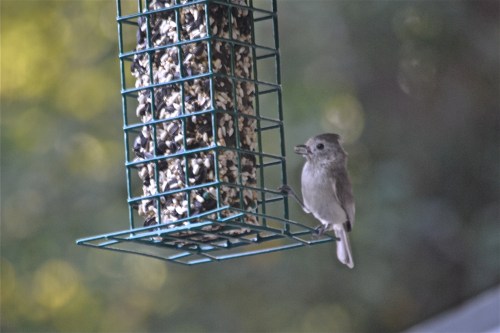
We’ve had some lovely birds greet us this spring, more than in recent memory. They feast on our seed — bars of Birdola songbird and gold finch feed that fit in a wire-cage bird feeder (though you can make your own feed, too. A recipe follows.)

Our visitors this year include the blue Western Scrub-Jay, the very cheery House Finch, and a young Titmouse. Which creatures are visiting you?

This is a really easy bird feeder to make:

Pinecone Bird Feeder

You’ll need:
• Pinecone (you can substitute a toilet-paper tube)
• 2′–3′ of string
• 1/2 cup vegetable shortening, peanut or other nut butter, suet, or lard
• 1/4 cup cornmeal or oatmeal
• 2 1/2 cups mixture of birdseed (e.g., sunflower and millet; check your local  nursery for suggestions), chopped nuts, and dried fruit
• Mixing bowl
• Plate, shallow dish, or pie tin
• Spoon or butter knife

Tie the string around one end of the pinecone.
In mixing bowl, combine peanut butter or other spread with meal.
Spread that mixture over the pinecone with the knife or spoon.
Pour the birdseed and feed ingredients onto the plate. Roll the pinecone in the seeds.
Hang from a tree branch or window eave.

Photos: Susan Sachs Lipman


Lyrid Meteor Shower May be Best in Years

The Lyrid meteor shower, expected to peak late Saturday night and into Sunday morning over North America, promises one of its best shows in years, astronomers say. Especially beneficial is Saturday’s near-moonless night. The Lyrids are set to peak after midnight, early April 22.

Spokespeople from NASA have gone as far as to observe:

If you must spend one night under the beckoning stars this month, make it April 21.

NASA folks themselves are planning to make the most of the event. They are launching a balloon cam from Bishop, CA, in the hopes of getting up-close meteor footage and they are offering an Up All Night NASA Chat, from 11pm-5am Eastern U.S. Time. Simply follow this link to ask scientists questions about the Lyrids.

The Lyrids (pronounced Lie-rids) have been observed for more than 2,500 years — during 687 B.C., Chinese records noted that “stars fell like rain”. Aside from some similar key years, most recently 1982, when 90 and more shooting stars were seen for a period of hours, the Lyrids have been a minor meteor shower.

Can’t watch it at the exact time? Don’t worry — astronomers tell us that meteor showers can last for hours before and after the peak date.

What is a meteor shower?

Meteors occur when the Earth passes through streams of dust and debris from ancient comets which have entered the Earth’s atmosphere. (When the comet has flown close to the sun, its dirty ice evaporated and that, in turn, caused the comet dust to spew into space.) The Lyrid meteor shower hails from the comet C/1861 G1 Thatcher, which orbits the Sun only once every 415 years, even though we see the Lyrids that result from it annually. The orbit of this comet appears to lie in the constellation Lyra, the source of the name Lyrids.

How to watch the Lyrid Meteor Shower

Meteors are best viewed with the naked eye. Sky watchers should grab a chair (ideally one with some neck support), and a blanket if it’s cold, and head outside where you can see the largest patch of night sky possible (with as little city light as possible), and look up.

Because meteor showers last for days before and after the projected peak, try to scan the skies during the surrounding days, if you can.

This American Meteor Society page is a great site for exploring more about the Lyrids and where and when to see them in your local night sky.

This video from NASA explains why April 21-22 should be an especially wonderful night for stargazing.

ScienceCasts; A Wonderful Night in April

Photo: Composite of 2009 Lyrids over Huntsville, Ala. (NASA/MSFC/Danielle Moser)


Join the Great Backyard Bird Count

I am very excited about the Audubon Society and Cornell Lab of Ornithology‘s upcoming Great Backyard Bird Count. It takes place Friday-Monday, February 17-20, all over North America. Anyone can participate, even if you only have 15 minutes and are completely new to birding.

Here’s how it works: You can pick a spot to go watch birds (a backyard, a park, a trail, a marsh, or anywhere you think birds might be) or you can join an organized event. You can download a very thorough check list of birds that are likely to be seen in your area. You record the birds that you see and then go home and either send in your checklist or enter the names and numbers in online.

There are lots more tips about counting and recording birds, tricky identifications, binoculars, and much more on BirdSource’s Great Backyard Bird Count page. The site also features recordings of bird sounds and more activities for kids.

The All About Birds site has beautiful photos and information that can help you identify birds. These are the top 10 birds that were reported during the count last year.

So, why count birds in the first place, and why now? The Cornell Ornithology Lab, the Audubon Society and others use the information from the annual February count to track the health of various bird species over time and, in some cases, take steps to protect them. Mid-February has proven a good time to count, as it occurs just before the major Spring migrations. If you find you like counting, you can actually help year-round on various projects.

Last year more than 11,400,00 individual birds were reported by more than 92,000 people. This year you could be part of the Great Backyard Bird Count.

Read about and see pictures of the 2010 Great Backyard Bird Count.
Get ideas for other great Citizen Science projects.

Photos: Painted Bunting and Green Honeycreeper by Doug Janson, Flame Colored Tanager by Jerry Oldenettel, Blue Jay: Creative Commons, Northern Spotted Owl by Susan Sachs Lipman

Hearts in Nature: A Valentine’s Day Scavenger Hunt

Everyone loves scavenger hunts. It’s great fun to be on the lookout for things. Hunts can turn a simple walk into an adventure or a game. They can cause us to look around in nature a little more closely than we may have.

In many parts of the world, a Valentine’s Day scavenger hunt can get you outside during winter. See how many heart-shaped objects you can find and keep track of the number of them as you explore. You may be surprised, once you look very closely, at just how many heart-shaped items there are in nature. I dug up a few around the internet:

New for 2013:

New for 2014:

For more inspiration, visit my Hearts in Nature photo album on Facebook.

Read the inspiration for this scavenger hunt, Active Kids Club’s Outdoor Valentine Link Up.

You might also like Love in Nature and in History.

Photos: Tariqweb, Public Domain, Public Domain, dvortygirl, Angi Unruh, Public Domain, Public Domain, Calum Redhead, Pixdaus, Public Domain, Public Domain, Public Domain, Claude Truong-Ngoc, Public Domain, Public Domain, aussiegirl, Bigstock, Bigstock

Fun Winter Activity: Create Ice Art

If winter’s cold weather has you thinking you can’t play outside, think again. There’s simple fun to be had by creating ice sculptures, or ice art. All you need are some empty containers with large openings, rain or tap water, food coloring, and some freezing weather to bring your winter artist out of hiding — or at least outside.

Gather a variety of empty containers with large openings, such as milk cartons, juice boxes, and disposable cups and bowls. Collect rain or water in your containers and color with food coloring, if desired. Leave the containers of water outside to freeze. Carefully remove your containers to reveal the ice sculptures!

Not cold enough where you live? No problem. Have fun making ice sculptures in your freezer!

Active Kids Club in Toronto and Sanborn Western Camps in Colorado both have excellent ideas and photos to inspire your ice art.

Go Explore Nature has lots of ideas for winter backyard nature fun, no matter what the weather!

Photos: Top – Active Kids Club, Bottom – Sanborn Western Camps


Look Up! It’s the Geminid Meteor Shower

Now playing overhead: The dramatic Geminid Meteor Shower, which many astronomers agree is the best meteor shower of the year.

The Geminid Meteor Shower is forecast to peak late Tuesday/early Wednesday Dec. 13-14, between around 10 p.m. and sunrise, at your local time, in North America. If you can’t stay up that late, not to worry — astronomers tell us that some meteors should be visible as soon as darkness hits. In addition, the shower lasts for days before and after the peak date, and there have already been reports from around the world of people spotting spectacular fireball-like celestial streaks.

Despite this year’s nearly full moon, NASA scientists, like Bill Cooke of the NASA Meteoroid Environment Office, still predict a good show. “Observers with clear skies could see as many as 40 Geminids per hour,” Cooke says .  “Our all-sky network of meteor cameras has captured several early Geminid fireballs.  They were so bright, we could see them despite the moonlight.”

What is a meteor shower?

Meteors occur when the Earth passes through streams of dust and debris from ancient comets which have entered the Earth’s atmosphere. (When the comet has flown close to the sun, its dirty ice evaporated and that, in turn, caused the comet dust to spew into space.) Scientists believe that the Geminids actually come from an asteroid, called 3200 Phaethon, which is really the skeleton of an extinct comet. The Earth passes through this particular debris stream each December, and is said to originate near the constellation Gemini.

How to watch the Geminid Meteor Shower

The Geminids should be visible with the naked eye in North America and perhaps in other parts of the world. Sky watchers in cold climates should bundle up, grab a chair (ideally one with some neck support), and perhaps a blanket, head outside where you can see the largest patch of night sky possible (with as little city light as possible), and look up.

Because meteor showers last for days before and after the projected peak, be sure to scan the skies during the surrounding days, if you can. This time of year, clouds can obscure the Geminids on the peak day, as can the moon, which will be nearly full.

A thermos of hot chocolate is a great accompaniment for the Geminids.

This shower has been getting stronger every year it’s been recorded, going back the the 1860s. It could be “an amazing annual display”, according Cooke of

This American Meteor Society page is a great site for exploring more about the Geminids and where and when to see them in your local night sky.

This movie of the 2008 Geminids comes from a space camera at the Marshall Space Flight Center:

Watch the 2008 Geminid Meteor Shower

Be a Citizen Scientist: Join the Great Sunflower Project

Do you have 15 minutes to spare? If so, you can be a citizen scientist. Over the past few years, citizen scientists — ordinary people who help scientists and organizations track the count and behaviors of such creatures as birds, butterflies, bees and others — have been active and helpful information gatherers. After all, researchers can’t be everywhere, and many of us have habitats in our backyards and neighborhoods that can help others gain important information about nature.

And, if that isn’t enough, citizen science makes a fun family or classroom activity, getting naturalists of all ages and abilities  outdoors together and providing them with something to do and a way to feel helpful and a part of the Earth’s larger ecosystem. Don’t let the name intimidate you. All you need to participate in citizen science is the desire to observe nature to the best of your ability for a period of time and record what you see.

Scientist Gretchen LeBuhn, of the San Francisco Bay Area, hopes to get thousands of people counting this weekend through her Great Sunflower Project. You can count bees on sunflowers, bee balm, cosmos, rosemary, tickseed, and purple coneflower. The instructions on the site are very easy to follow and complete.

Pollinators (a group in which bees are in important member) affect 35 percent of the world’s crop production, studies have shown. In recent years, bee populations have declined so drastically, due to climate and environmental change, that scientists are struggling to understand and reverse what they call  “colony collapse disorder”.

Us citizen scientists can help identify where native bee populations are doing well and where they’re doing poorly. Even if you can’t help this weekend, planting sunflowers or other bee-friendly flowers can help the bee population in your area.

The Great Sunflower Project takes place July 16 this year. (Updated for 2013: The Great Sunflower Project is August 17, but you can participate any time.) There are lots of other great citizen science projects. Some are event-based and others are ongoing.

These include:

The Great Sunflower Project
Project Feeder Watch
The Great Backyard Bird Count
Lost Ladybug Project
Monarch Watch
Firefly Watch
Frog Watch USA
National Wildlife Federation‘s Wildlife Watch
Ice Watch
Acoustic Bat Monitoring
Hummingbird Migration Map
Project Budburst
Project Squirrel
The Weather Observer Program
NASA Meteor Count
Snow Tweets

Still looking for more fun citizen science projects? Check out SciStarter or Cornell’s Citizen Science Central.


Have fun!

You might also enjoy:

Have Fun Attracting Bees, Butterflies and Birds

2010 Great Backyard Bird Count

Read Join Project Feeder Watch

Photos by Susan Sachs Lipman


Related Posts Plugin for WordPress, Blogger...