Category Archives: Play

Slow News: Slow Family Movement Featured in USA Today

Slow Parenting is in the news again, as more and more parents are discovering that dialing back the amount of organized and scheduled activities for kids can lead to more family time and the sense of fun and calm that accompany it.

USA Today just featured the slow family movement, in an article that originally appeared in the Sioux Falls Argus Leader, and features my compatriots at Slow Family Living, Bernadette Noll and Carrie Contey, whose workshops, workbooks and wisdom have been helping families slow down.

The article shares the ways in which some families have chosen to slow down and their creative solutions for making family time fun, meaningful and a source of memories and bonding.

Much current research backs up the need for the kinds of free play and family togetherness that doesn’t happen when children are constantly engaged in organized activities. Some of this thinking comes from Dr. Kenneth Ginsburg, author of Building Resilience in Children and Teens, who assures us, “There are no more valuable means of promoting success and happiness in children than the tried, trusted, and traditional methods of play and family togetherness.”

Perhaps that’s something to think about as we enter the busy holiday season.

You might also be interested in:

Back to School: How to Tame Fall Frenzy
Coming Next Spring: Fed Up With Frenzy: Slow Parenting in a Fast-Moving World
Slow News: Movement to Restore Free Play Gains Momentum

A great source of research is:

The Children & Nature Network

Photo by Susan Sachs Lipman

Book Provides Inspiration for Halloween Fun

As an unabashed enthusiast for all things Halloween, I loved Maggie da Silva‘s very charming and thorough ebook, Real Family Halloween Fun. Maggie is also the author of The Real Family Camping Cookbook, and her flair for providing complete information in a fun and accessible way is again evidenced here.

Maggie provides everything you need for a memorable and fun Halloween. There are ideas for lots of different costumes, including last-minute ones, from unicorn to superhero. Thorough guidelines take the reader through every step of throwing a Halloween party, including themed decorations and music, invitation text, traditional and obscure games ranging from fortune telling to Halloween hunts, and fun and unique treats like Witches’ Fingers and Mummy Mealoaf. As a pumpkin lover, I’m “dying” to try the pumpkin cupcakes with cream cheese frosting.

Maggie’s holiday spirit is completely infectious. I especially enjoyed her forays into Halloween history and her section on old-fashioned and forgotten Halloween fare, such as Barnbrack and Colcannon from Ireland, and Boxty and Soul Cakes from the U.K. Real Family Halloween Fun is rounded out with crafts, lore and even poetry, which succeeds in putting the reader in the Halloween mood while taking much of the guesswork out of bewitching celebrations of any scale.

For more information on downloading, see Real Family Time.

New Childrens Book Reminds us to Play

Ernestine Buckmeister, the heroine of a delightful new children’s book, written by Linda Ravin Lodding and illustrated by Suzanne Beaky, doesn’t have time for childhood. This is so “…because her busy, well-meaning parents had packed her after-school schedule.” Mondays are for clay sculpting, Tuesdays for water ballet, Wednesdays for knitting and Thursdays for tuba playing. The week is rounded out with yodeling, karate and yoga.

Sound familiar? Though slightly exaggerated, Ernestine’s schedule gently acts as a mirror of over-scheduled children whose anxious parents are afraid that childhood is limited and convinced that children are in need of efficient delivery of experiences and skills.

But something happens to Ernestine. She discovers the joy of unstructured play and friends to play with, and influences her parents (and nanny, in a nice touch) to seek a little balance in the process.

The Busy Life of Ernestine Buckmeister is completely charming. Its message is delivered in a gentle, funny way, with cute plays on words and illustrations that are cheerful, colorful and winning. The repetition and order of words and of Ernestine’s routine would appeal to young children. It’s quite easy to imagine this book becoming a favorite of children and parents as well as a wonderful, sly reminder of the importance of slowing down for childhood and for play.

You might also like:

Movement to Restore Free Play Gains Momentum
Enjoy the Ancient Art of Cloud Watching
Babies Learn by Playing
How to Tame Fall Frenzy
Children Opt for the Box Over the Toy

Back to School: How to Tame Fall Frenzy

The flood of school-related papers seems to come earlier each year – the “first day” packets, the emergency and permission forms, the sports and other schedules. The start of school seems earlier, too — it’s up to mid-August in my neck of the woods.

A peruse around the internet shows that I’m not alone in feeling dismay at the loss of the long and leisurely summer. Parents in Chicago and Newburyport, MA, successfully lobbied their school districts to start school after Labor Day. Indiana senators are trying to mandate a statewide post-Labor Day start to school.

Hopefully, you were fortunate to have had some leisurely family time this summer. Or, at the very least, some time free from homework, schedules, transportation, meetings, appointments, a busy calendar and a frazzled household. No matter when Back-to-School hits for you, it can be a challenge and a desire to keep the pace and spirit of summer in your family. Here are a couple of ideas for taming Fall frenzy.

Create Unstructured Family Time

Consider turning down the occasional invitation or activity to ensure that your family has some time by itself. Then devote to that time by not answering the phone and emails, and putting away the electronics and the to-do list. Families need to regroup and simply have unstructured time together – to play, to talk, to inadvertently create the small instances that go into the family memory bank. It is the little things that tend to bond families, and these often occur during unstructured time. This can be time to explore a craft or make music, just for the fun of it – in contrast to being in “achievement mode”. It can be a time to have a family game night or be outside in nature, to tell stories that meander as you do, or to merely observe the world. In earlier cultures, it was more common for people to take a break from the everyday. Today, in our 24/7 world, we sometimes have to create that time for ourselves and our families, in order to refresh, as well as re-engage with one another. If need be, schedule a family night on the calendar.

Eat As Many Meals As Possible Together

You’ve heard it before, but it bears repeating. Mealtimes are often the only times families have together. It can be incredibly grounding to just sit down all together at the end of the day and share triumphs and thoughts. It can take some planning to find the time between activities and work for everyone to come together, as well as the time to plan and prepare meals. If you enjoy cooking, doing so as a family can provide fun bonding time. If not, aim to keep weeknight meals simple and buy what you need for a few meals at once, to keep cooking and shopping times down, as well as costs. You can also make double batches of food, and then have the leftovers the next night. Or pick up take-out food on your way back into the house. While home-cooked meals are great, the time spent together is even more vital.

Spend Time in Nature Together

Nature’s schedule is so much broader than our busy one, that one can’t help but gain a little perspective simply by being outside. And, chances are that when you’re outside as a family, you’re getting some fresh air, physical beauty and exercise, which enliven the spirit as well as help create healthy habits for everyone. For some children, nature is where they feel happiest, and there are plenty of ways to enhance their experience of nature, whether through creating poetry or art out of what is observed, collecting items to display at home, playing games like Tag and Hide ‘n Seek, building forts, watching stars, or telling stories and playing word games together while on walks. Other families might enjoy biking, rollerblading or water sports as a way to be active together and do something a bit special. Chances are, even if you live in a city, there’s a bit of nature nearby. Looking for ideas? Check out the Children & Nature Network.

Cultivate Friendships With All Different People

Have people in your life who are different ages than you, or whom you don’t know through your child. Sometimes what gets lost as a parent is a sense of who we are as people, and others – with whom me might share non-parenting interests – can help us reconnect with that part of ourselves and with a broader range of interests and ideas than may be prevalent in the immediate circle of school. People who don’t have school-age children may be less harried themselves, so that you can’t help but slow down in their presence. Perhaps there is a neighbor or friend with whom your family would enjoy taking a walk or doing a craft. Especially if there are no grandparents nearby, a relationship with someone older can be a wonderful, life-enlarging experience for a child. Many senior facilities welcome young visitors with a parent. Performing a service, such as visiting a shut-in, is an excellent way to slow down, gain perspective and make a friend.

Say “No” to More Things

We parents don’t have to volunteer to take on more at work, or to serve on every school committee that needs us. Periodically assess your needs and your output and, if something is out of balance, readjust. Likewise, children don’t have to sign up for a lot of activities. Often, children are over-scheduled to the point of creating stress for the whole family. Perhaps explore one or two activities at a time, and carefully consider costs and benefits before adding any new ones. It may help to assure yourself that it is usually not the last opportunity for your child to enjoy ballet or soccer. More pleasure may come from devotion to one thing at a time.

Evaluate Your Own Desires

Are you signing your child up for activities you would have liked for yourself? While exposure to many things is delightful and, indeed, a luxury, too much of a good thing can backfire. Try to be clear about whether your own needs or anxieties about your child’s achievement are fueling a desire to over-schedule activities. Often what children want, when asked, is simply more unstructured time with their siblings, friends or parents.

Make Time for Yourself and Your Spouse

This is often the first thing that gets bumped off the list of priorities. Adults who are burned out have no resources left for their children. Perhaps, having cleared more time for family time, some self and couple time can emerge as well. If need be, schedule time to spend alone, as a couple, or with friends from other parts of your life, even if you can only do so once a month. Consider doing more family activities that, while age-appropriate, are not necessarily child-focused. Sometimes children come along on our activities more readily than we expect them to, and the results can be rewarding for everyone.

Get Enough Sleep

Missing out on sleep puts everyone in a bad mood, which can add to daily stress. Try to have a regular bedtime for children and for yourself. If work remains to be done into the night, tell yourself it can wait until tomorrow. If there’s time, a nice routine before bed, such as reading out loud (to children of any age) can be calming and put a nice cap on the day, which helps everyone get to sleep better.

Let Children be Children

Sometimes, in our rush toward achievement, we forget what it is like to be a child. Childhood still lasts about 18 years, which leaves plenty of time for  structured activities. Some unstructured time for children (to be alone, as well as with the family) is desirable. Don’t be afraid to let your child have down time, to daydream or explore on his or her own. To even — be bored. Every activity doesn’t have to lead to a future goal. And every moment doesn’t have to provide outside entertainment. In fact, our tendency to over-schedule and over-stimulate children can create undue stress for them, as well as the inability to simply entertain themselves, play freely, tolerate stillness, or discover their own inner compasses — who they are and what they like to do.

Photos by Susan Sachs Lipman

These tips were adapted from Fed Up with Frenzy: Slow Parenting in a Fast-Moving World, which contains 300+ fun family activities and slowing techniques.

Celebrating 100 Years of the Mill Valley Library


This past weekend, I had the pleasure of participating in an old-fashioned party to celebrate my wonderful town’s library, which turned 100 years old. Originally built as a Carnegie Library, in what is now a stately brick house, the Mill Valley Public Library has grown from an institution with 750 donated books to one with 132,000 books, a digital collection, a team of librarians, and live offerings almost every day it’s open, from noted local authors to pre-school story times, to performances outdoors and in. No wonder our library thrives while others around the country are forced to close. Hundreds of visitors per day find it relevant and exciting, a true community hub.

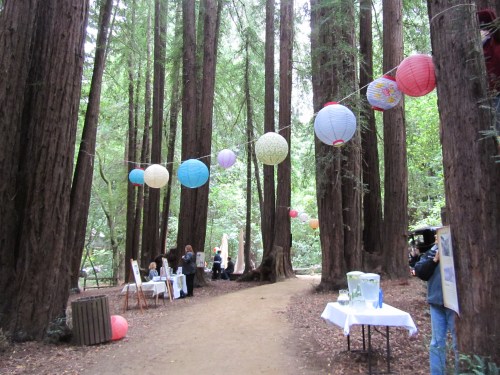
It was terrific then, and very fitting, to honor the library’s Centennial with a gathering in the grove of redwoods that adjoins it. There was a free and continual program of old-time music, a birthday cake, announcements and proclamations, sodas and hot dogs, crafts, library trivia contests, and games, which I led with Research Librarian Cara Brancoli and which, in keeping with the historical spirit, included Tug-of-War, Three-Legged Races, Sack Races, and Egg-and-Spoon Races. We also had jacks and hula hoops out for free play. Wonderfully, many children, especially the smaller ones, rolled the hoops, just as children may have done 100 years ago.

It was truly lovely and warm (in spirit, if not temperature.) Liz Greer of Mill Valley Life took some wonderful photos that really captured the event, as did Hans Roenau in the Mill Valley Patch.

Photos: Top, Liz Greer. Bottom, Ken Friedman. Others: Susan Sachs Lipman


Slow Down for Summer: Fun and Simple Outdoor and Seasonal Activities

I had such a great time on the Slow Down for Summer webinar that I did with KaBOOM! and with the many participants. We shared tons of Slow Summer ideas that emphasized fun and ease over equipment and preparation. These include old-school playground games that are ripe for a comeback and can be played most anywhere, crafts to get you outside on a nice summer day, activities to help kids observe and enjoy their surroundings (be they nature or city), and garden and harvest projects to help kids appreciate the cycles of nature and of life. There was so much information and so many wonderful ideas, that we just skimmed the surface in the time allotted. I think it got everyone thinking about the possibilities for wonder and fun and how to create more of each in their everyday lives. I know I came away with some great ideas!

You can visit the webinar anytime to get an idea of some of the things we discussed. And, of course, many of them can be found on my blog, on in future blog posts, as well as in my upcoming book, Fed up With Frenzy: Slow Parenting in a Fast-Moving World.

Enjoy your Slow Summer!

Photos by Susan Sachs Lipman

You might also like:

Make this Easy Tie Dye Project
Loom and Finger Weaving
11 Ways to Make Gardening Extra Fun for Kids
How to Save Nasturtium and Other Seeds
Blueberry Tuesday: Summer Triple Berry Crisp

Slow Down for Summer: Join me for a Webinar June 30th and Find out How

Yearn to slow down and fully enjoy summer? I will share lots of great ideas Thursday, June 30, 11 am Pacific Time, 2 pm Eastern Time in the U.S., in a Slow Down for Summer webinar hosted by KaBOOM!, an organization that supports play and helps communities erect great playspaces.

Games, crafts, activities, and more will be covered. You’ll come away with fun, simple and inexpensive ideas for making the most of your family time and the season.

In, addition, I’m giving away four signed copies of CEO Darell Hammond‘s New York Times bestseller, Kaboom: How One Man Built a Movement to Save Play. To enter in a random drawing for the books, leave a comment here about your favorite way to play (and let me know if you’d like to sign up for my email list) or sign up to receive occasional Slow Family email news in the right column of my blog and leave a comment here that you did. (If you’re already a subscriber, and you wish to be entered in the drawing, leave me a comment and let me know.) Entries are due by Midnight, Eastern Time. June 29th.

You can also register for the webinar in advance.

Happy Summer!

Photos by Susan Sachs Lipman

Dance Around a Maypole for May Day

May Day, or Beltane, comes at the exact mid-point of Spring and, as such, calls for celebration. The first maypoles were pine trees, which were carried in processions to Ancient Roman temples to honor the goddess Flora. In Pagan Medieval Europe — especially Germany, England, the Slavic countries and parts of Scandinavia — a tree would be cut down and brought from the woods into the village by a procession at sunrise, while horns and flutes played. The tree, a maypole, would be festooned with ribbons, garlands, flowers, wreaths, and other decorations to celebrate Beltane.

I’ve had the good fortune to take part in a few Maypole dances, with family and community groups. The tradition remains a special and delightful one that honors the season in a way that takes participants back to a more gentle and pastoral time.

You’ll need:

A tall tree branch or pole and something to anchor it. (Volleyball, tetherball, flag, umbrella and wooden poles work. 8-10 ft. is the optimal height.)

An even number of ribbons, at least one per dancer, in various colors, each 1½ times the length of the pole

Hammer and nails

Shovel, optional

Nail one end of each ribbon streamer to the top of the pole.

Anchor the pole into a pre-made umbrella or other stand, or dig a deep hole in the ground and make sure your pole is anchored properly in it.

Your maypole is ready for the dance.

The Roman Floralia festivals lasted up to a week and featured games, theatrical presentations, and floral-wreath adornments. During the early Floralias animals were set free and beans were scattered to encourage fertility. At different times in history, Floralias and May Day celebrations were bawdy affairs.

The holiday, which actually marked the first of summer for many years – with our current summer solstice being Midsummer) has always featured feasting and dancing, and often the crowning of a May Queen and King. In parts of England, and then in Puritanical America, leaders tried to do away with the Pagan holiday, but the charming, sweet aspects of the celebration have remained.

The maypole dance is beautiful and joyous, as the dancers weave ribbons weave in and out of each other’s steps systematically, until the ribbon-covered pole is left with a specific pattern. You may want to instruct dancers and have them practice in advance of the actual Maypole Dance.

You’ll need:

A decorated maypole

Dancers

Live or recorded music

Have participants each hold a ribbon around the pole.

Every other person should face clockwise, with the others facing counter-clockwise. (Have young children count off 1-2, 1-2 to determine which way to face.)

Dancers will alternate — first going in towards the pole, and under the ribbon of person coming towards them, then going out away from the pole, raising their ribbon over the person coming towards them. (To start, tell the 1s that they will go in and under and the 2s that they will go out and over.)

There is even a chant people may want to do:

In and out, in and out,
Weave the ribbons tight;
‘Round the Maypole we will dance
To the left and to the right.

The dance is over when the pole is completely wrapped with ribbons.

These celebrants in Glastonbury, England, look like they know what they’re doing and are having fun doing it.


See my earlier May Day post for instructions for making floral wreaths.

Happy May Day!

Photos by Susan Sachs Lipman

In GPS Era, Map Reading Skills a Lost Art

This article relates a tale that is no doubt being played out all over the developed world:

Two college students playing in an out-of-town hockey tournament went out to eat with their parents after a late game, but the restaurant they picked had just closed its kitchen.

“There’s another place just a few blocks away,” the hostess said helpfully. “Take a left out of the parking lot, go two blocks, turn right and go one block.”

The parents and the players retreated to their separate cars. When the players sat in the parking lot for a couple of minutes without moving, one of the parents walked over to see if there was a problem with the car.

“Not at all,” they said. “We’re just programming the directions into the GPS.’ ”

Is that where we’ve ended up, with a younger generation that can’t go three blocks without being told by a electronic voice where to turn?

Like the author, I found this story dismaying. I know GPS (Global Positioning System) and similar devices are helpful, but they can also be a crutch and, ultimately, a detriment.

According to the British Cartographic Society, high-tech maps get the user from Point A to Point B but leave off traditional features like geographic and built landmarks, and this could lead to a loss of cultural and geographic literacy.

I, too, find the GPS experience extremely limiting, especially when visual or voice commands tell me (sometimes incorrectly) where to turn just before the turn needs to be made. With a map, preferably one on paper, one can pull out to a bird’s eye view, get a complete picture, plot a route, and have true satisfaction and awareness about ones place within it.

Nothing wrong with having a GPS as a back-up, but I see far too many people who completely depend on them, to the degree that, like the boys in the restaurant parking lot, they’re afraid to travel anywhere, even a few blocks, without one.

One study, from the University of Tokyo, found that people on foot using a GPS device actually made more errors and more stops, and walked farther and more slowly than traditional map users. They also demonstrated a poorer knowledge of the terrain, topography and routes.

GPS, researchers say, encourages people to stare at a screen, rather than looking around at their environment. Also, most GPS screens makes it impossible for a user to take in both their location and their destination at the same time.

Ah, there’s that Big Picture again.

There are additional consequences to over-reliance on GPS devices. I wrote last year about Nature Disconnect in Britain. It seems that a lack of map skills is actually somewhat responsible for keeping a whole generation of children there, and surely elsewhere, homebound, fearful of exploring, playing, and being outside in the unknown. Children’s very sense of adventure is being terribly circumscribed.

Luckily, there are steps being taken to combat this. This list of ideas ranges from walking in ones neighborhood and making friends, to creating neighborhood green spaces and safe pedestrian and bike routes, to educating parents about unfounded fears. And, of course, one can and should learn basic map reading skills.

Interestingly, technology is helping with the latter, as geocaching (group scavenger hunts which use GPS devices) as well as old-school scavenger hunts continue to gain popularity. In addition, the Boy Scouts have responded to the crisis in map reading by upping their universal requirements for using a compass and map. (Girl Scouts also offer geocaching and orienteering badges and programs.)

Debi at Go Explore Nature offers some tips for getting out and geocaching.

Where is the paper map in all this? Some say it’s going the way of the phone booth and the milkman. I’m sure many of you remember family car trips, during which the map was unfolded, dutifully followed with index finger on highway line, and then folded up, yet never in quite the same neat way it had come. (We still honor this practice in our family and begin many adventures with a trip to the California Automobile Association, which stopped producing paper maps a few years ago.) Indeed, maps are on their way to becoming collectors items.

Here’s hoping that you get to enjoy the tactile pleasure of an old-school map, the inner satisfaction of locating your place, the fun of an outdoor scavenger hunt or other adventure, and the gift of knowing which way is up.

Images: Hands on Museum, Built St. Louis, Route 66 Guidebooks, Ferrell Digital

Slow News: Movement to Restore Free Play Gains Momentum

As many of you know, I’ve been riding the hobby horse of free play for some time on this blog, as have many other delightful and like-minded colleagues.

Now the New York Times has chimed in:  The culture of play is vanishing, Hilary Stout writes. It’s an all-too-familiar tale — children’s face-time with electronic screens is growing, their outdoor world and their freedom within it are shrinking. Organized activities have replaced imaginary and child-directed ones. Fear of litigation and/or academic fallout have caused some schools to do away with recess. Some parents hover; some are too busy; some don’t like the mess ..

It has all added up to a culture in which free play is not valued or experienced. The New York Times tells us that the tide may be turning. They cite many groups that are working toward enhanced free play, such as Kaboom and Play for Tomorrow, which created a “play day” in New York’s Central Park last fall, with more than 50,000 attendees!

People, clearly, yearn to play.

The folks at the Rhode Island Children’s Museum would concur. Their Play Power program largely came about because they noticed that children were starting to be conditioned to want to be told the “right way” to play. And parents seemed to be oriented to outcomes, rather than the process of playing.

From the Strong Museum of Play in Rochester, NY, comes this resource about the benefits of free play.

Susan Linn, author of The Case for Make Believe, has a lot to say about children’s need for play, including:

A good toy, a toy that nurtures creative play is ninety percent child and only ten percent toy.

From Education.com comes a really good piece about the importance of free play, how it may have been lost and how to get it back.

Last April, I wrote about the trend toward toys that fostered children’s imaginations and led to open-ended play, and included the wonderful story of the Children’s Discovery Museum in San Jose, CA, which built a whole Box City when they realized that kids were happier playing with empty boxes than with some of their installations.

Since then, I came across another delightful tale of box play.

Other great resources and people fostering the free play movement include The Alliance for Childhood, The National Institute for Play, Playborhood, and The Children & Nature Network, among others. (There are more on the Slow Family Resource Page.)

Want to explore more? The U.S. Play Coalition is holding a Conference on the Value of Play, Feb 6-9 at Clemson University in Clemson, S.C.

Whatever you do, keep playing! And fostering a love of play in your kids.

Related Posts on Slow Family: Babies Learn by Playing

Photos by Susan Sachs Lipman

Related Posts Plugin for WordPress, Blogger...