Category Archives: The Great Outdoors

Look Up! (And Bundle Up): The Geminid Meteor Shower is Putting on a Show

Now playing overhead: The dramatic Geminid Meteor Shower, which many astronomers agree can be one of the most intense meteor showers of the year.

The Geminid Meteor Shower is forecast to peak late Friday/early Saturday, Dec. 13-14, about two hours before dawn, at your local time, in North America. If you can’t stay up that late, not to worry — astronomers tell us that some meteors should be visible as soon as darkness hits and as late as December 16.

Despite this year’s nearly full moon, NASA scientists, like Bill Cooke of the NASA Meteoroid Environment Office, still predict a good show, especially for those willing to rise  before dawn. “The Geminid meteor shower is the most intense meteor shower of the year,” Cooke says. “It is rich in fireballs and can be seen from almost any point on Earth. Even a bright moon won’t completely spoil the show.”

Enjoy a live Geminid Meteor chat and video stream with NASA Scientists, Friday, December 13, 11 p.m.-3 a.m. EST.

What is a meteor shower?

Meteors occur when the Earth passes through streams of dust and debris from ancient comets which have entered the Earth’s atmosphere. (When the comet has flown close to the sun, its dirty ice evaporated and that, in turn, caused the comet dust to spew into space.) Scientists believe that the Geminids actually come from an asteroid, called 3200 Phaethon, which is really the skeleton of an extinct comet. The Earth passes through this particular debris stream each December, and is said to originate near the constellation Gemini.

How to watch the Geminid Meteor Shower

The Geminids should be visible with the naked eye in North America and perhaps in other parts of the world. Sky watchers in cold climates should bundle up, grab a chair (ideally one with some neck support), and perhaps a blanket, head outside where you can see the largest patch of night sky possible (with as little city light as possible), and look up.

Because meteor showers last for days before and after the projected peak, be sure to scan the skies during the surrounding days, if you can. This time of year, clouds can obscure the Geminids on the peak day, as can the moon, which will be nearly full.

A thermos of hot chocolate is a great accompaniment for the Geminids.

This shower has been getting stronger every year it’s been recorded, going back the the 1860s. It could be “an amazing annual display”, according Cooke of

This American Meteor Society page is a great site for exploring more about the Geminids and where and when to see them in your local night sky.

This movie of the 2008 Geminids comes from a space camera at the Marshall Space Flight Center:

Watch the 2008 Geminid Meteor Shower

Enjoy Fall, Nature, Cooking and Reading with Kids

Hello Friends! You may have noticed that my blog has been sparse the last couple of months. I appreciate your visits and checking in. I haven’t been completely quiet. I have been writing some interesting things for other blogs and thought I’d share here.

Celebrating the Seasons Helps Promote Family Bonding, Parents Place

Autumn and the Outdoors: Experiencing Nature’s Benefits with your Children, Center for Childhood Creativity

9 Ways to Tame Fall Frenzy, Frugal Mama

When Toys “R” Us Pits Toys Against Nature, the Children and Nature Movement Wins, Children & Nature Network

Raising Readers in the Digital Age, Dot Complicated

Cooking with Kids: 31 Days of Unforgettable Recipes, Stuff Parents Need

Also, look for these Fall favorites on my blog:

Join Project Feeder Watch, and other Citizen Science Activities

Make a Beaded Corn Ear for Thanksgiving

31 Awesome Pumpkin Recipes

Make a Fall Leaf Placemat

How to Make an All American Apple Pie

Honor Your Family with Fun Gratitude Crafts

I look forward to sharing more seasonal and parenting fun in the weeks ahead. Thanks again for stopping by.

Photos: Susan Sachs Lipman

10 Ways to Preserve the Spirit of Summer in Your Family Year-Round

It was the apex of my childhood, over and over
––  inscription in a beach house guest book

For most families, summer is a season lasting approximately 12 weeks. Into it, we pack most of our relaxation for the year, along with our memories, our entertaining, and our sensual experiences –– whether they involve digging our toes into wet sand at the ocean’s edge or biting into a stack of mozzarella, tomato and basil, drizzled with olive oil, and swearing we can taste the Mediterranean.

It’s the season when the sun kisses our faces and causes our children’s height to spurt. It’s the season of wearing less clothing; spending more time with family and friends; eating fresh, tree-ripened fruit; and spending nights playing games or gazing at stars. In summer, time moves just a little more slowly.

When asked to name a childhood memory, most adults will remember an incident or a feeling from summer. While we can’t actually experience the golden season in December, there are a few fun and meaningful ways to harness the spirit of summer for our families to enjoy year-round.

Make Summer Food and Drinks

Many people associate the foods of summer with spots around the globe that bask in warm climates for much of the year. Think Mediterranean, Middle Eastern, African, Southeast Asian, South American, Mexican, Caribbean, Hawaiian, and regional U.S. dishes that use fresh fish, meats, cheese, vegetables, and herbs, and combine ingredients simply for results that are sensuous and robustly flavored. Cooking from warm climates is not only delicious, but can put you in a summer frame of mind any time of year. Try making Chicken Mole, Ratatouille, Easy Weeknight Fish Tacos, All Season Slaw or Pineapple Upside Down Cake. Recreate your favorite barbecue recipes that can be made in an oven or broiler. Roast marshmallows in a fireplace or over a stove flame for s’mores.

Or make the yummy Mango Lassi (instructions at the bottom of this post.)

Camp in Your Living Room

Camping in sleeping bags is fun any time of year, indoors or out. Rustle up some s’mores in a fireplace or over an oven flame. Sing your favorite campfire songs. Tell stories. Make Hand Shadow Puppets by having someone project a flashlight onto a wall, a practice that goes back 2,000 years to Han Dynasty China! (Instructions at the end of this post.)

Have a Summer Movie Marathon

A dead-of winter double feature or an all-out film festival can put your family back in a summer frame of mind. Make s’mores and watch a rustic- or camp-themed movie like The Parent Trap (original and remake), The Great Outdoors, Camp Nowhere, Meatballs or Cheaper by the Dozen 2. Show a classic summer beach or surf movie (and try to explain to your kids that bathing suits really looked like that):  Beach Blanket and Gidget series, Blue Hawaii or The Endless Summer. Enjoy popcorn and a fun road-trip movie, such as It’s a Mad Mad Mad Mad World, Are We There Yet? and National Lampoon’s Vacation. Have pre-teens or teens? Show Sisterhood of the Traveling Pants, One Crazy Summer, Stand by Me or The Flamingo Kid.

Garden for Wildlife Year-Round

Some of the best moments for enjoying birds and butterflies occur during the fall, winter, and spring, even in cold climate zones. This can be when animals most need food and shelter. Watching animal activity, outside or even out a window, can brighten a gloomy day and encourage us to be better in tune with the cycles of nature, especially when we know we’re helping animals find food just when it can be hardest for them to do so. Plant a simple habitat garden with plants that attract birds and butterflies. Make and hang an easy bird feeder and watch the birds enjoy the eatery!

Grow Your Favorite Herbs

Take a page from French gardeners and employ your own potager –– a simple, accessible kitchen garden –– all year. Many herbs do very well in small indoor containers or on a kitchen windowsill. These include basil, chives, cilantro, scented geranium, parsley, sage, rosemary, thyme, and edible flowers. You can also grow lettuce indoors. Enjoy the simple act of growing and snipping a sprig of your herbs to add to a soup, a salad or a meal.

Preserve Food

The best preserved food is made from ingredients that are picked and canned or bottled at their peak of ripeness  –– To open a jar and eat a spoonful of blueberry jam in mid-winter is to taste the summer in which it was made. Even Napoleon, not known for being the world’s most sensuous guy, seemed to understand this on a gut level. After all, it was he who offered an award for the person who could invent a way of preserving food for his armies. That, in turn, led to the modern practice of “canning”, making and preserving jams and other foods to eat all year long. If you still have berries, make my favorite triple berry jam. Berries gone? Then it’s time for yummy apple butter.

Jars of homemade jam make great gifts that recipients know are from your kitchen and your heart. Decorate the jars by tying on a custom gift card with a pretty ribbon. Or make a simple jar topper, which finishes a jar of jam in an especially old-fashioned and pleasing way. Instructions at the bottom of this post.

Preserve Memories with Your Family and in Your Home

Small items can have a lot of power. Did you collect sea shells, rocks, beach glass, trip souvenirs or other items? Have fun creating a display of them that you can enjoy all year long. Or make a mobile of your sea shells by poking holes into them with needles, stringing them on fishing line, and attaching the fishing line to sticks. Frame and hang a map from one of your favorite summer locales. Frame or make an album of vacation or summer photos and view them as a family on a winter’s day. Have family members share their favorite summer memories with one another. You may be surprised at everyone’s picks!

Gaze at the Stars

Even though summer’s Perseid meteor shower tends to get all the glory, fall and winter offer some of the best star shows of the year. If conditions are right, you’ll want to bundle up, make some hot chocolate, pull up a comfortable chair, and look through binoculars, a telescope, or the good ol’ naked eye at the Geminids, or the Leonids, or enjoy the marvelous constellations year-round.

Play Games

My summer memories often involve playing games. There seems to be more time in summer for family play, both indoors and out. Try to keep the lightness in your family and your schedule that allows for play. Play is vital for children’s development and family bonding, and is downright fun! Try these fun playground games.

Indoors? Have a family game night and play one of our favorite card games, Slapjack (instructions at the end of the post.)

Foster a Summer Mindset

In addition to warm weather, summer is often special because families approach the season with mindfulness and joy. Try unplugging or continuing to unplug earlier in the day and more often to create family time. Take walks in nature and play indoor and outdoor games, no matter the season. Keep the calendar as light as possible, even if it means saying “no” to some things or scheduling in family time. Treasure the small moments, which just may become big memories.

In the depth of winter, I finally learned that within me there lay an invincible summer. 

–– Albert Camus

Mango Lassi

People in India and around Southeast Asia have been drinking lassis (pronounced “luh-sees”), sweet or spicy yogurt-based drinks, for thousands of years. And, with colorful lassi stands on streets all over the subcontinent, their popularity shows no sign of letting up. For good reason. This cooling drink is great after a spicy meal or on a hot day. It works as a breakfast or a dessert. The yogurt base (traditionally a dahi, which is closer to a curd) is said to enhance digestion. And the offering of a lassi is a gesture of friendship. Yes, all this from a drink.

1 c. plain yogurt

½ c. milk

1 c. frozen mango cubes, slightly thawed

1 Tbsp. sugar

¼ tsp. ground cardamom

dash of nutmeg, if desired

Note: the yogurt and milk can be full-fat, no-fat, or anything in between.

You can make this drink with one medium fresh mango and add ½ c. of crushed ice, if desired. You can also make a berry lassi by substituting frozen berries for the mango, or season the drink with cumin or mint.

Place all ingredients except nutmeg in a blender and puree for two minutes or until the mixture is smooth and any chunks of frozen mango are fairly small.

Pour into tall glass.

Shake nutmeg on top, if desired.

Serves 1

Hand Shadow Puppets

Rabbit – Make a fist with one hand. Place the other palm over it and make a peace sign (for ears) with two fingers.

Hawk – Link your thumbs together, with hands facing away from you. Stretch your fingers and hands and flutter them like wings.

Spider – Cross your hands at the wrist. Press your thumbs together to form the spider’s head. Wiggle your fingers in a climbing motion.

Wolf or Dog – Place your palms together, fingers facing away from you. Put your thumbs up to form ears. Let your pinky drop to form a mouth. Bend your index fingers to create a forehead.

Camel – Lift one arm. Hold your hand in a loosely curved position. Hold the pinky and ring finger together. Hold the other two fingers together, thumb pressed in. Curve both sets of fingers and hold them wide apart to form a mouth. Your arm, from the elbow up, will be the camel’s neck.

Jam Jar Topper

You’ll need:

Fabric pieces (fat quarters used for quilting work well)
Pinking shears or scissors
Rubber band
Ribbon (enough for the circumference of the lid, plus approx. 8”)
Glue, optional

Cut a circle of fabric, approx. ¾” larger all-around than the jar band.

If desired, place a dot of glue onto the top of the lid, and place the fabric onto it.

Secure the fabric with a rubber band.

Tie the ribbon around the rubber band to cover, and tie it into a bow.

Attach a gift card or jar label, if desired.

Slapjack

The Deal: Cards are all dealt, one at a time, to all players. It doesn’t matter if some players have more cards than others.

Object: To win all the cards, by being first to slap each jack as it is played to the center.

Players take turns lifting one card from his or her pile and placing it face up in a common pile at the center of the table. Players must be careful not to see their own cards first. Whenever a jack is turned, the first player to slap it takes all the cards in the common pile and places them in his or her own pile.

When more than one player slaps at a jack, the one whose hand is directly on top of the jack wins the pile. If a player slaps at any card in the center that is not a jack, he must give one card, face down, to the player of that card. When a player has no more cards left, he remains in the game until the next jack is turned. He may slap at the jack in an effort to get a new pile. If he fails to win that next pile, he is out of the game. Play continues until one player has won all the cards.


Other Slow Family posts you might like:

Back to School: 9 Tips for Taming Fall Frenzy

Seven Ways to Make Summer Last Longer

These activities are adapted from Fed Up with Frenzy: Slow Parenting in a Fast-Moving World, which contains 300+ more fun family activities.

Enjoy the Fall Harvest Moon and Equinox

Songwriters have crooned about it. Farmers have counted on it. The Chinese Mid-Autumn, or Moon, Festival honors it with special mooncakes. It’s the Harvest Moon, the full moon closest to the Autumnal Equinox, which traditionally shines its all-night beacon to help farmers gather their crops. In addition to being timed well for the job, this Autumn full moon travels particularly close to the horizon in the Northern Hemisphere, so that it appears larger and closer than do other full moons throughout the year. It’s also visible for a longer amount of time than other moons — often all night — so that, especially before electricity, the harvesting needn’t stop at nightfall. And, if that weren’t enough, it also brightens the night sky for many successive days in a row.

For most of a week, those in northern latitudes are able to go outside on clear nights and witness the Harvest Moon. It’s due to be its fullest on the night of September 18 or September 19, depending on your location on the globe. In North America, the crest of the moon’s full phase comes before sunrise September 19. at 11:13 UTC. That’s 4:13 a.m. U.S. Pacific Daylight Time  on September 19, 2013.  Translate UTC to your time zone.

Asians will witness the full moon after sunset September 19, the night of the Mid-Autumn Festival.

This year’s Autumnal Equinox falls on September 22, at 20:44 UTC . That’s 1:44 p.m. Pacific Daylight Time. “Equinox” means “equal night” in Latin and, twice a year (in March and September), the sun shines directly on the equator, and the length of day and night are nearly equal in all parts of the world.

The Farmers Almanac calls the Fall full moon the Harvest, or Corn, Moon. The Choctaw Native Americans called it the Mulberry Moon, and the Dakota Sioux called it the Moon When the Calves Grow Hair.

I’ve long been quite entranced with the full moon names and their variations. Of course, they reflect both the need to mark passing time and the way that time was experienced by people who were living close to the land. Lunar time-keeping pre-dated our modern calendars (and some calendars, like the Jewish and Chinese calendars, are still lunar-based.) The Farmer’s Almanac has a good list of Native American full moon names and how each came to be.

Other, even older, cultures have had moon naming traditions, too. This site lists full moon names from Chinese, Celtic, Pacific Island, Native American, Pagan, and other cultures.

In addition to harvesting, some people even plant and garden by the phases of the moon.

I hope you enjoy fine Equinox and Harvest Moon, whether you’re harvesting food, memories, or warm family full-moon nights.

Gaisberg_and_rising_full_moon


Photos: Roadcrusher, Matthias Kobel

You might also enjoy:

The Wheel of the Year: Summer Turns to Fall
Walt Whitman’s Ode to the Harvest
Fall Foliage at its Peak
Celebrate May’s Full Moon
Happy Equinox and Super Moon

Back to School: 9 Tips for Taming Fall Frenzy

The flood of school-related papers seems to come earlier each year – the “first day” packets, the emergency and permission forms, the sports and other schedules. The start of school seems earlier, too — it’s up to mid-August in my neck of the woods.

A peruse around the internet shows that I’m not alone in feeling dismay at the loss of the long and leisurely summer. Parents in Chicago and Newburyport, MA, successfully lobbied their school districts to start school after Labor Day.  Legislators in many states hotly debate back-to-school dates each year.

Hopefully, you were fortunate to have had some leisurely family time this summer. Or, at the very least, some time free from homework, schedules, transportation, meetings, appointments, a busy calendar and a frazzled household. No matter when Back-to-School hits for you, it can be a challenge to keep the pace and spirit of summer in your family. Here are a couple of ideas for taming Fall frenzy.

Create Unstructured Family Time

Consider turning down the occasional invitation or activity to ensure that your family has some time by itself. Then devote to that time by not answering the phone and emails, and putting away the electronics and the to-do list. Families need to regroup and simply have unstructured time together – to play, to talk, to inadvertently create the small instances that go into the family memory bank. It is the little things that tend to bond families, and these often occur during unstructured time. This can be time to explore a craft or make music, just for the fun of it – in contrast to being in “achievement mode”. It can be a time to have a family game night or be outside in nature, to tell stories that meander as you do, or to merely observe the world. In earlier cultures, it was more common for people to take a break from the everyday. Today, in our 24/7 world, we sometimes have to create that time for ourselves and our families, in order to refresh, as well as re-engage with one another. If need be, schedule a family night on the calendar.

Eat As Many Meals As Possible Together

You’ve heard it before, but it bears repeating. Mealtimes are often the only times families have together. It can be incredibly grounding to just sit down all together at the end of the day and share triumphs and thoughts. It can take some planning to find the time between activities and work for everyone to come together, as well as the time to plan and prepare meals. If you enjoy cooking, doing so as a family can provide fun bonding time. If not, aim to keep weeknight meals simple and buy what you need for a few meals at once, to keep cooking and shopping times down, as well as costs. You can also make double batches of food, and then have the leftovers the next night. Or pick up take-out food on your way back into the house. While home-cooked meals are great, the time spent together is even more vital.

Spend Time in Nature Together

Nature’s schedule is so much broader than our busy one, that one can’t help but gain a little perspective simply by being outside. And, chances are that when you’re outside as a family, you’re getting some fresh air, physical beauty and exercise, which enliven the spirit as well as help create healthy habits for everyone. For some children, nature is where they feel happiest, and there are plenty of ways to enhance their experience of nature, whether through creating poetry or art out of what is observed, collecting items to display at home, playing games like Tag and Hide ‘n Seek, building forts, watching the stars, or telling stories and playing word games together while on walks. Other families might enjoy biking, rollerblading or water sports as a way to be active together and do something a bit special. Chances are, even if you live in a city, there’s a bit of nature nearby. Looking for ideas? Check out the Children & Nature Network.

Cultivate Friendships With All Different People

Have people in your life who are different ages than you, or whom you don’t know through your child. Sometimes what gets lost as a parent is a sense of who we are as people, and others – with whom me might share non-parenting interests – can help us reconnect with that part of ourselves and with a broader range of interests and ideas than may be prevalent in the immediate circle of school. People who don’t have school-age children may be less harried themselves, so that you can’t help but slow down in their presence. Perhaps there is a neighbor or friend with whom your family would enjoy taking a walk or doing a craft. Especially if there are no grandparents nearby, a relationship with someone older can be a wonderful, life-enlarging experience for a child. Many senior facilities welcome young visitors with a parent. Performing a service, such as visiting a shut-in, is an excellent way to slow down, gain perspective and make a friend.

Say “No” to More Things

We parents don’t have to volunteer to take on more at work, or to serve on every school committee that needs us. Periodically assess your needs and your output and, if something is out of balance, readjust. Likewise, children don’t have to sign up for a lot of activities. Often, children are over-scheduled to the point of creating stress for the whole family. Perhaps explore one or two activities at a time, and carefully consider costs and benefits before adding any new ones. It may help to assure yourself that it is usually not the last opportunity for your child to enjoy ballet or soccer. More pleasure may come from devotion to one thing at a time.

Evaluate Your Own Desires

Are you signing your child up for activities you would have liked for yourself? While exposure to many things is delightful and, indeed, a luxury, too much of a good thing can backfire. Try to be clear about whether your own needs or anxieties about your child’s achievement are fueling a desire to over-schedule activities. Often what children want, when asked, is simply more unstructured time with their siblings, friends or parents.

Make Time for Yourself and Your Spouse

This is often the first thing that gets bumped off the list of priorities. Adults who are burned out have no resources left for their children. Perhaps, having cleared more time for family time, some self and couple time can emerge as well. If need be, schedule time to spend alone, as a couple, or with friends from other parts of your life, even if you can only do so once a month. Consider doing more family activities that, while age-appropriate, are not necessarily child-focused. Sometimes children come along on our activities more readily than we expect them to, and the results can be rewarding for everyone.

Get Enough Sleep

Missing out on sleep puts everyone in a bad mood, which can add to daily stress. Try to have a regular bedtime for children and for yourself. If work remains to be done into the night, tell yourself it can wait until tomorrow. If there’s time, a nice routine before bed, such as reading out loud (to children of any age) can be calming and put a nice cap on the day, which helps everyone get to sleep better.

Let Children be Children

Sometimes, in our rush toward achievement, we forget what it is like to be a child. Childhood still lasts about 18 years, which leaves plenty of time for  structured activities. Some unstructured time for children (to be alone, as well as with the family) is desirable. Don’t be afraid to let your child have down time, to daydream or explore on his or her own. To even — be bored. Every activity doesn’t have to lead to a future goal. And every moment doesn’t have to provide outside entertainment. In fact, our tendency to over-schedule and over-stimulate children can create undue stress for them, as well as the inability to simply entertain themselves, play freely, tolerate stillness, or discover their own inner compasses — who they are and what they like to do.

Photos by Susan Sachs Lipman

These tips were adapted from Fed Up with Frenzy: Slow Parenting in a Fast-Moving World, which contains 300+ fun family activities and slowing techniques. This post also appeared in Frugal Mama.

Enjoy Roadside Attractions along California’s Redwood Highway

This post is part of the Sunshine Kids California Blog Hop.  See below for details and more kid-friendly California posts!

If you love a budget-friendly mix of roadside attractions and natural awe, northern California’s Highway 101, from Leggett to Scotia, offers a wonderful stretch of road that feels like something from a slower era.

Heading north, start at the town of Leggett, about 175 miles north of San Francisco, and the Drive-Through Chandelier Tree. Yes, you really can drive (and walk, if it’s not too crowded) though this 315-foot-tall coastal redwood tree.


The tree was believed to have been carved in the 1930s. The park has a lake and quiet picnic spots.

Just north of Leggett is the roadside attraction, Confusion Hill , which offers a miniature train ride in summer and lots of old-school believe-it-or-not-style physical features that play with your idea of gravity and level ground.

A tourist attraction since 1949, Confusion Hill is listed as a California State Point of Historical Interest. It’s both modest and kitsch and full of low-key fun.

Travel another 25 miles or so North on Highway 101 to the entrance of the Avenue of the Giants, a separate, stunning, road that parallels the 101 for 31 beautiful miles, from Garberville to Scotia. This stretch, also known as State Route 254, is home to some of the oldest-growth redwood trees in the world, the oldest of which may be as old as 2,000 years. (Most redwoods live 500-700 years.)

Originally a stagecoach road, the Avenue of the Giants was officially dedicated in 1960. It seemed that the new,  high-speed Highway 101 allowed the Redwood route to become, in the California governor’s words,

a serene drive where kids and families can cross the road at will, where traffic moves at a far slower pace.

It’s amazing to be in a tunnel of truly majestic redwoods. There are more opportunies to experience world-famous drive-through coast redwoods. There are also opportunities for hiking, strolling, playing, fishing, swimming and camping.

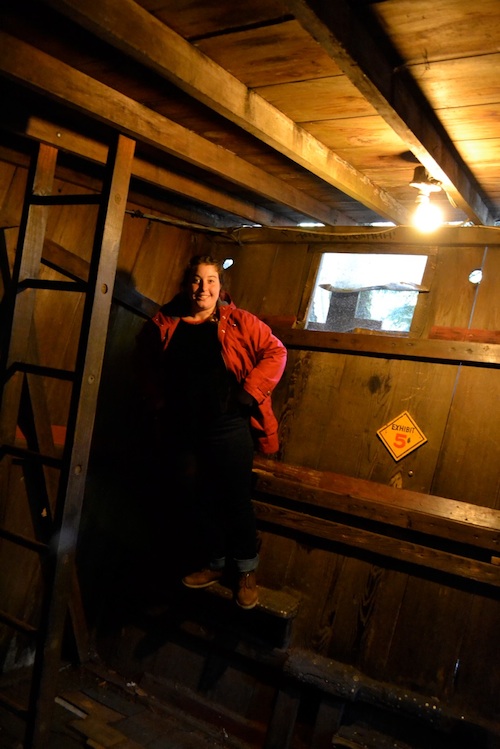
The whole area is rich with more wonderful and strange tourist stops, like the One Log House and Hobbiton, USA, both in Phillipsville, the nearby Legend of Bigfoot attraction. The road is further dotted with eatieries, small motels, and burled-redwood artisan shops. It’s worth meandering the stopping in various places. We’ve ridden this highway in summer and winter and never find it crowded.

I highly recommend driving the Avenue of the Giants and Highway 101, perhaps in conjunction with a trip to San Francisco, or the northern CA or southern OR coast.

The Save the Redwoods League offers fun activities to help families explore the Avenue of the Giants.

Photos by Susan Sachs Lipman, wikipedia

This post is part of the Sunshine Kids California Kids Blog Hop. I’m thrilled to participate. Please join in!

Sunshine Kids California Blog HopThe Sunshine Kids California Blog Hop celebrates all that is wonderful about raising kids in the Golden State.

Link up your kid-centered posts about California: places to visit, books to read, crafts to create, recipes to try, and so on.

The blog hop will run from August 19 to September 2.

Thanks to Akane of Juggling With Kids for the beautiful photo!

You can also check out even more California posts on our collaborative Kid Friendly California Pinterest board!

Be sure to check out our upcoming project, Exploring the California Missions!


Participating Blogs:

All Done Monkey InCultureParent.com - Raising little global citizens.
Kids Yoga Stories The Silly Pearl
The Art Pantry 2KuriousKids
A Mom With a Lesson Plan
Adventure Bee
Capri+3
Juggling With Kids
Little Hiccups
Slow Family The Good Long Road Adventures in Wunderland

Link up your kid-centered California posts below!


Seven Ways to Make Summer Last Longer

While many of us are preparing our kids to go back to school, the calendar and weather still signal summer. The days are longer, our to-do lists are less crowded. Even if you never let go of frenzy for summer, or you’re feeling it now as you gear up for fall, there are a few small shifts that can really help you lighten up to match the remaining summer season, while also helping squeeze more true pleasure from this joyous time of year.

Make a Summer Bucket List

For many, summer conjures beach days, county fairs, gazing at the stars, planting flowers, playing flashlight tag, or making simple crafts. What else would you and your family really like to have done by the time Labor Day comes around? Make a summer bucket list of ideas and hang it where you can see it, or write each idea on a piece of paper or a popsicle stick and place those in a bucket. Have one family member choose an activity once or more per week for the rest of summer. Don’t feel like you have to do everything on the list – you can do many of your favorites another time.

Watch the Sun Rise or Set

The day naturally slows when we take the time to witness a dramatic and beautiful sunrise or sunset. Get comfortable, pay attention to the changing colors and light, and make a point to either greet or say goodbye to the day. This small act can be very grounding and gratifying to people of all ages, as it truly takes us out of the artificial time of clocks, calendars, emails and to-do lists, and into the rhythms of nature and the comforting, yet awe-inspiring, turning of the Earth.

Make Time for Down Time

Many of us are uncomfortable with empty spaces on the calendar. As difficult as it may be, and as enriching as many choices are, try to resist the urge to schedule every moment of summer. Kids actually need play time, down time and family time in order not only to recharge, but also to fully thrive. In addition, they don’t need to be constantly entertained. Free time, and even boredom, has produced wonderful innovations and insights. It is often during quiet time that many children make unique discoveries, including the directions of their own inner compasses. If down time doesn’t come naturally to you, schedule some into your calendar. This can be especially important as everyone gears up for a busier season.

Be Present and Do One Thing at a Time

Have you ever noticed that kids are usually not doing and thinking about multiple things at once? This is one area in which we can probably learn from them. Many of us parents would be surprised by how much our kids just want to be with us, and how our multitasking makes them feel. In studies of hundreds of kids over five years, Dr. Sherry Turkle, director of the MIT Initiative on Technology and Self, unearthed countless stories of children feeling neglected by their parents for media.

Try to compartmentalize your work and other tasks, so that they don’t invade precious time with your family. Because of the allure of electronics, we often have to turn our devices off as well, so that we can devote our attention to the people we’re with and the activities we’re doing without being distracted by alerts and the occasional itchy-fingered desire to check in with the electronic world.

Give Your Electronics the Day Off

Electronic media is so incredibly seductive for people of all ages that sometimes we need to take things a step further and formally unplug for a period of time in order to experience our families, selves and time. Follow the direction of most of the world’s religions and cultures and call a scheduled day of rest each week, for a day, a night, or a few hours. If you’re constantly plugged in, it can be very enlightening to see what happens when you get quiet, and also when you do get back to media. It is usually emergency-free and easier to get back into the flow of work and communication than we envision.

In addition, many TV shows contain anxiety-provoking images and messages. Try cutting out one or more TV shows per week and substituting them with a family walk or game.

Be a Tourist in Your Town

We often think we have to engage in awesome (read expensive) summer vacation travel, when sometimes the simplest experiences can prove the most delightful, especially for younger children. Get up early one day and watch the stores and businesses in your town receive their deliveries and come alive. Visit your nearest large city and partake in a true tourist activity that you’ve never done before. Walk or ride bikes as a family in a new neighborhood. You may be surprised by just how much fun everyone has, trying new things and seeing local surroundings with fresh eyes. If you have younger ones and do have time when others go back to school, that can be a great time to explore a city without the summer tourists.

Enjoy Your Family

Summer often means extended time with your family and with that inevitably comes some days that are more trying than others. Try to keep in mind that this phase will pass, summer only comes once a year, and the kids will only be this age once. If having other parents around helps, participate in group activities, either with a buddy or through a structured program. Relish the good times and the memories you’re forming now. Chances are that summer’s smallest moments will be the ones you regard with the most fondness later.

A version of this post originally appeared in Dot Complicated.

These tips were adapted from Fed Up with Frenzy: Slow Parenting in a Fast-Moving World, which contains 300+ tips and fun family activities.

Photos by Susan Sachs Lipman

You might also like:

8 Fun Things to Do While it’s Still Summer
Summer Family Fun: Make and Experiment with Giant Homemade Bubbles
Tidepooling with Kids: Explore Undersea Creatures
Stir Up Some Triple Berry Jam

Perseid Meteor Shower Will Light Up the Night Sky This Weekend

You might see a lot or you might not see many, but if you stay in the house, you won’t see any. — EarthSky Magazine


The annual Perseid meteor shower is coming our way this weekend. Anyone who lives in the Northern Hemisphere may be in for a good old-fashioned sky show, just by looking up.

The Perseids are debris from a wandering comet that appears as shooting stars each August. (Records of this light show go back to 36 A.D., though the Swift-Tuttle Comet was discovered much later.) They often provide one of the best shows of the year, if the skies are clear and the moon is not full.

Astronomers are predicting an especially good show this year, the peak of which will be Sunday, August 11 and Monday, August 12. Midnight Sunday to dawn Monday should provide the best viewing under a half-full moon. Sometimes meteors can be seen up to a week before and after a shower’s peak.  Astronomers are predicting as many as 70 meteors an hour for those who are able to see the Perseids. (That said, we always see fewer meteors than these predicted numbers, so don’t be disappointed. One fantastic shooting star blazing through the sky can produce lifelong memories and awe.)

You won’t need any special equipment to see the Perseids. The naked eye is actually best. Just be sure to give your eyes some time to adjust to the dark. And hope for a good show! Here are more tips for viewing the Perseids.

The San Francisco Chronicle offers more information about the Perseids, along with some good viewing tips and a sky map.

If you like, you can even be a citizen scientist and help NASA count meteors! Download a free app for iphones and androids and join the meteor count. (Here are more citizen science projects you might be interested in.)

Some of my family’s most relaxed and memorable moments have occurred while gazing at the stars together. You can’t help but be infused with a sense of wonder, history and mystery while contemplating the cosmos. It’s natural to share those feelings with those around us, as we use the stars to try to look back through distance and time.

My family remembers one especially wonderful August, when we went to the top of our nearest mountain to see the Perseid meteor shower. Lying in the grass in the dark, we could hear choruses of “oohs” and “aahs” coming from all around the mountain, as people caught sight of the meteors blazing through the night sky. Of course, this year, we’ll be outside again, somewhere, looking for the beautiful Perseids.

Enjoy the show!

Photo: Eta Aquarids by Jason Gunders, Queensland, Australia

See this guide to other Meteor Showers Throughout the Year

Enter the OgoSport PlayRefuel Contest

Outdoor Play Equipment from OgoSport

Where do you and your family like to play and eat?  Share your tips and take part in OgoSport‘s PlayRefuel Summer Contest! The contest is designed to help families discover places to eat and play in cities and towns across the U.S.  Share your favorite playgrounds, parks and outdoor spaces (Play), and/or places to grab a bite with kids (Refuel). You’ll be entered in a drawing for a $250 OgoSport gift basket and other fun prizes. The contest runs through August 31. Winners will be announced in fall.

Here’s how to play:

1. Enter OgoSport’s Twitter or Facebook contest page: playrefuel.com/2013contest

2. Click on either Twitter or Facebook.

3. Submit the name and location of a favorite place to eat or play and two brief descriptions of what you like about it.  If on Twitter, use the hashtag #playrefuel; on Facebook enter the contest link for details.

You can also send submissions via a postcard or letter to:

OgoSport, LLC
Brooklyn Navy Yard, Bldg. 3 Suite #408
63 Flushing Avenue, Unit 137
Brooklyn, NY 11205

4. Each submission – up to 10 – will enter your name in our raffle drawing for a chance to win a $250 OgoSport gift basket in addition to other prizes.

Get inspired by OgoSport’s disks, darts, bits, kits and other fun sports equipment for outdoor play.

I look forward to playing, refueling, and sharing my top spots for both.

The OgoSport Mini Disk FORA


This post is sponsored by OgoSport. The opinions expressed are my own.

Photos: OgoSport


Enjoy June’s Full Supermoon

Look up in the sky! It’s Supermoon! On Saturday, June 22 and Sunday, June 23, the moon will appear especially large and bright, due to its closer-than-usual relation to Earth. This supermoon, or perigee moon, will be the largest-appearing moon of 2013.

The supermoon will rise from the east around sunset, and then will appear huge and low on the horizon before rising into the sky for the night. Because the moon will be at its fullest Sunday at 7:30 am EDT, both Saturday and Sunday should offer ideal viewing opportunities for those with clear skies.

Read more science behind the supermoon.

Read tips for photographing the supermoon.

The Full Moon

Of course a supermoon is by definition full. People in many cultures throughout history have named the year’s full moons based on the activities that happened during them. The Farmers Almanac calls the June full moon the Strawberry Moon because, for the Algonquin Native Americans, June was synonymous with strawberries. The Cherokee called the June full moon the Green Corn Moon. The Choctaw referred to it as the Windy Moon. Celtic people referred to the June full moon as the Moon of Horses. Throughout much of more modern Europe, the June full moon was known as the Rose Moon, for that flower’s peak.

I’ve long been quite entranced with the full moon names and their variations. Of course, they reflect both the need to mark passing time and the way that time was experienced by people who were living close to the land. Lunar time-keeping pre-dated our modern calendars (and some calendars, like the Jewish and Chinese calendars, are still lunar-based.) The Farmer’s Almanac has a good list of Native American full moon names and how each came to be.

Other, even older, cultures have had moon naming traditions, too. This site lists full moon names from Chinese, Celtic, Pacific Island, Native American, Pagan, and other cultures.

Full Moon Gardening

Lots of people garden using the phases of the moon. The good news is that there isn’t one best time to plant — Each aspect of planting has an associated moon phase, based on how much moisture is pulled up through the soil by the monthly pull of the moon (much the way the moon influences the tides.)

The time just after the full moon is an especially good time for planting root crops, as the gravitational pull is high (adding more moisture to the soil) and the moonlight is decreasing, contributing energy to the roots. For this reason, the waning moon is also a good time to plant bulbs and transplants.

The Farmer’s Almanac offers a wonderful moon phase calendar for the U.S. that allows you to plug in your location and get the exact time of your local full moon.

Whether planting or watching, enjoy June’s full supermoon!

Graphics and Photos: Optics Central, Public Domain, NASA, Susan Sachs Lipman

Related Posts Plugin for WordPress, Blogger...