Tag Archives: Food

Sonoma-Marin County Fair Opens Today

sonomamarin5

The Sonoma-Marin Fair is here!

I love county fairs, and we in the Bay Area have an abundance of great fairs to choose from. Because it straddles two counties that each have a fair later this season, the Sonoma-Marin Fair can be overlooked. This fair, in Petaluma, has been my family’s favorite for years.

All your fair favorites are here: a midway with tons of traditional food, like corn dogs and funnel cakes, good rides for all ages, carnival games, food and animal exhibits, live music and performances, and lots of special contests. Over the years, we’ve seen sheep shearing, cheese carving, cow milking, hypnotists, and contests for everything from gathered wool to painted shoes.

x
sonomamarin7

sonomamarin2

The Sonoma-Marin Fair has a down-home feeling, which is in keeping with Petaluma’s farming and historical roots. There are a lot of animals to see and activities for small children. It’s also not as large or crowded as some other fairs, making it particularly appealing for families.

The Sonoma-Marin Fair is in town Wednesday, June 24 through Sunday, June 28. We plan to be there opening day and will report back.

For directions, hours, events and more, see the Sonoma-Marin Fair site.

See you on the midway!

sonomamarin6

Photos by Susan Sachs Lipman

Cheese of the Week: Juniper Grove Tumalo Tomme Goat Cheese

cheesejunipergrovetumalo

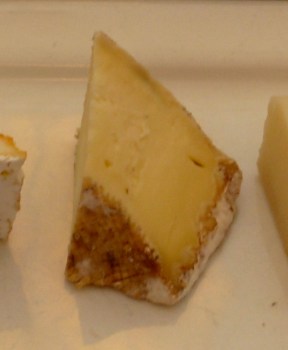
The world’s longest lasting cheese course (lucky us!) continues with a Tumelo Tomme Goat’s Milk cheese (also known as Tumelo Classico) from Juniper Grove Farm in Redmond, Oregon. This is a lovely cheese, with a firmer texture than you might ordinarily find in a goat cheese, which results in something like a goat gouda. It’s a solid, pleasing cheese, with a lot of body in the mouth.

The goat aspect takes a moment to hit you and, when it does, it is equally pleasant and on the mild side. (The Haystack Mountain Queso de Mano, which was on the same plate, is bolder.) There are nutty and sweet, even caramel-like notes, along with an earthy, slightly mushroom-y taste.

Redmond Grove Farm’s owner/cheesemaker, Pierre Kolisch, studied cheesemaking in Normandy with master cheesemaker Francois Durand, and cites European “tomme” cheeses as an influence. (“Tomme” loosely means small cheese from partial milkings, with the “tomme” and “toma” names in particular use in the French and Italian Alps.)

Tumalo is a raw-milk cheese, made from milk from Redmond Grove’s herd of goats, which feed on alfalfa year-round on beautiful land east of Oregon’s Cascade Mountain range. (Indeed, Tumalo bears the name of a local village.) Kolisch employs traditional farmstead methods in his cheesemaking, such as separating curds from whey, and then brining, stacking and hand-turning the washed-rind cheese, as it ages on pine planks in a dry, cool environment for three months.

The result is this nice, lovingly made goat cheese.

The Tomalo Tomme works well with crackers, grapes, apricots, or a fruity red wine, such as Pinot Noir or Merlot.

Girlfigcheesecourse

Photos by Susan Sachs Lipman

Congratulations: Edible Marin & Wine Country Magazine Launches

EdibleMarin2

The premiere issue of Edible Marin & Wine Country magazine is out, and it’s gorgeous. It’s filled with stunning photos and wonderful information about Marin, Sonoma, and Napa food and the growers and artisans who create it. There are plenty of recipes and ideas for home cooks and gardeners, as well as inspiration and information about where to find the best local, sustainably grown food and information about the Slow Food movement in general.

Publisher Gibson Thomas has been spearheading the Marin-Sonoma chapter of Slow Food since 2002, and her passion for our local bounty of incredible food and its producers is palpable.

After reading about Mill Valley’s Cici Gelateria, in the issue’s sweet rundown of ice cream and gelato shops that use local, sustainable ingredients, my family popped in for a selection. There’s only a hint of a relationship between Cici’s gelato and traditional ice cream. The gelato’s fresh flavors come through quite strongly and deliciously, without relying on an overuse of sugar or fat. We sampled a rich, hazelnut pistachio; a very minty mint chocolate chip; and a salted chocolate that offered a complex mix of tastes not often found in frozen desserts. (I’ve also had the pleasure of enjoying a couple of Cici’s more novel flavors, which are periodically available, such as a delicious lavender vanilla, and a refreshing, wonderful cardamom.)

The magazine also made me want to forage for edible greens along my local roadsides, get to Napa’s Oxbow Market, and create wonderful dishes with heirloom tomatoes. Best, it truly made me appreciate my local community of food growers, purveyors and enthusiasts.

Edible Marin & Wine Country is available by subscription and is distributed free at Whole Foods and other markets. Not in Marin/Napa/Sonoma? Fear not. There are Edible publications covering communities from San Diego to Cape Cod, with plenty of stops in between.

Photo by Susan Sachs Lipman

Cheese of the Week: Fiscalini Farms Bandage Wrapped Cheddar

fiscalinicheddar

Moving further along our superb Girl and the Fig cheese course, in order of distinctiveness (to me), we find the Fiscalini Farms Bandage Wrapped Cheddar. This was my husband’s very favorite cheese on the plate.

It is, indeed, a special cheese. It has a wonderfully strong, complex taste that features a mix of salty and sweet flavors. There are hints of grass and nuts, along with a pleasing buttery quality.

Far from the gummy, uninteresting, mass-produced cheddars that can give this cheese a bad name, the Fiscalini is dry and on the crumbly side, without sacrificing any creaminess of texture. It’s aged 18 months, using unpasteurized milk from the Fiscalini Farmstead cows and traditional methods that include bandage-wrapping the wheels in cheesecloth. The cheesecloth lets the cheese breathe as it ages and lends it a nice porous rind.

The Fiscalini Cheese Company, in the California Central Valley town of Modesto, has been operating since 1914. Their current cheesemaker, Jorge “Mariano” Gonzalez, studied at Montgomery Farms in England and perfected his methods at Shelburne Farms in Vermont. His bandage-wrapped cheddars consistently win awards, competing with such cheddar stalwarts as Neal’s Yard Dairy in England.

Cheddar doesn’t boast the same name-protection as some other European cheeses, which can only call themselves by certain names if they come from specific geographic areas. As such, cheddar is produced in many parts of the world. The first cheddars were created in Medieval times, in the village of Somerset, England, and it is the “Somerset model” that some use to determine a true traditional farmstead cheddar.

Randolph Hodgson, the proprietor of Neal’s Yard Dairy, has worked with the Slow Food Movement to develop standards for artisan Somerset cheddar. These include using unpasteurized milk from a farm’s own herd, employing traditional “cheddaring” methods, like stacking and turning the curd by hand, and aging at least 11 months. Aside from geographic considerations, Fiscalini fits the bill, and is the only American farm to do so. (Shelburne Farms makes a clothbound cheddar, but it is in extremely limited production.)

After enjoying this tangy cheese, it will be harder for me to take the cheddars for granted. Pair the complex Fiscalini with a hearty ale or a fruity wine, and crisp apple slices. Due to quality and price, I’d make it a nibbly cheese, rather than a cooking cheese. And I’d certainly give it its rightful place on the cheese board.

Girlfigcheesecourse

Photos by Susan Sachs Lipman

Slow News Day: Vermont’s First IHOP to Serve Real VT Maple Syrup

When International House of Pancakes finally opened a franchise in Vermont (the 50th state to get an IHOP), its General Manager, Sam Handy, Jr., successfully petitioned the franchisor to allow the South Burlington shop to serve real maple syrup, instead of the corn syrup blend that is served at the other approximately 1,400 IHOPs in North America. Handy is quoted in the New York Times as saying, “(Vermont is) a small state, and buying local is important.” He also wants to explore buying eggs and dairy items from local farmers.

So, it seems that fast food, in Vermont anyway, just inched a tiny bit slower.

Not to be outdone, New York Senator Chuck Schumer recently proposed to IHOP CEO Julie Stewart that New York State’s IHOPs similarly wean themselves off their mass-produced toppings and onto maple syrup made in New York. This is not the senator’s first foray into the maple. Last year, he introduced legislation designed to — wait for it — tap into his state’s underused maples by providing incentives to landowners for producing syrup. More information on New York’s maple situation is here.

I love maple syrup, and one in particular, which we have been getting delivered (a luxury) since trying it and many like it on a delightful road trip through New England five summers ago. That syrup is from Sugarbush Farm, in Woodstock, VT, where we got to touch the actual maple trees and learn about the entire tapping and production process. We also learned that we generally prefer the robust Grade A dark amber syrup to the lighter Grade A medium amber, or the even lighter “fancy” syrups.

frenchtoast

Lucky me. My daughter and her friend whipped up some French toast for themselves and for me this weekend. We all agreed that it turned out picture-perfect, especially topped with Sugarbush maple syrup and a helping of super-sweet Delta Blue organic blueberries from Stockton, CA., the closest-grown berries we could find.

Photo by Susan Sachs Lipman

Cheese of the Week: Haystack Mountain Queso de Mano Goat Cheese

haystackqueso

Continuing down our Girl and the Fig cheese plate, I really enjoyed the Queso de Mano goat cheese, from Jim Schott’s award-winning Haystack Mountain Goat Dairy in Niwot, Colorado. This is a superb raw-milk cheese — it has a wonderful, prominent, goat taste that is slightly sweet, and carries with it an undertone of nuttiness, as well as a hint of its farmstead grass and herbs. All that makes it terrifically complex and interesting, especially if you love goat-milk cheeses, as I do.

The Queso de Mano also manages to combine a firm texture with a velvety mouth feel. The cheese is aged four months and has a natural washed rind. It would be great with toasted almonds, fresh cherries or apricots, and a good fruity red wine.

For a long time, Haystack Mountain was the last remaining dairy in Boulder County. Sadly, local and other business expenses forced the company to sell its goats to the State Prison in Canon City, Colorado, which has operated an inmate-run dairy for 70 years. The upshot, though, is that the company is still producing and distributing its fabulous cheese from its headquarters in Longmont, Colorado, inmates at Canon City are doing fruitful work and learning a skill, and the Nubian, LaMancha, Sanaan and Nubian Cross goats are continuing to thrive and produce the milk that goes into Haystack Mountain’s cheeses.

The Queso de Mano is the second cheese from the right:

Girlfigcheesecourse

Photos by Susan Sachs Lipman

Cheese of the Week: Bohemian Creamery Bo Poisse

bopoisse2

I recently ducked into the fantastic Girl and the Fig restaurant in Sonoma and shared a wonderful cheese course with My Man. Of the six cheeses, the Bo Poisse, from Lisa Gottreich and Miriam Block’s new Bohemian Creamery in Bodega, was the absolute standout. The first thing that hits you about Bo Poisse is its sweet, pungent smell. When you bite into it, you find a delightfully creamy, almost wet cheese that tastes of mushroom, cream, a slight bit of ash. This is followed up by a lusty, tangy finish that brings with it more than a hint of a barnyard on a hot afternoon.

This cheese totally commits — As such it’s not for everyone. I loved it.

Bohemian Creamery is a small-batch, artisanal producer. They handcraft each round on their seven-acre farm, much of the milk coming from their own goats. The cows-milk Bo Poisse is made with milk from neighboring Jerseys. The washed-rind cheese is created using an Epoisse recipe. The French village of Epoisses is known for its pungent, soft, washed-rind cheeses. Napoleon was supposedly a fan, as was early epicurean/writer Brillat-Savarin, who called it “the king of all cheeses”.

The restaurant’s bubbly, sweet Fig Royale proved a nice companion to the complex cheese. I could see Medjool dates working with it, as well. Though my husband had other favorites on the cheese board (that’s what makes the world go ’round, plus more Bo Poisse for me), I can’t wait to have this cheese again, and I wish Bohemian Creamery great cheese-wheel-shaped success.

Look for my other reviews from this tasting, as we work our way down the cheese plate, bit by bit.

Girlfigcheesecourse

Photos by Susan Sachs Lipman

Red, White & Blue — Cookies!

Suzcookie1

We made these really fun cookies for Memorial Day. They’re called Beautiful Colorful Cookies and they’re in the Williams-Sonoma Kids Cookies book that we use all the time. My daughter Anna even entered a four-color batch in last year’s County Fair. They’re a tasty shortbread-like cookie, with a great crunchy texture. But, of course, the real star is the fun, unexpected colors. We use professional paste frosting colors (you can get a box of 8 small color jars from ChefMaster, available at specialty baking stores, for around $7), and, though they color well, it takes a lot of patience to get a super deep color in a cookie. You can see my husband, Lippy, had more patience than me when he was coloring this batch.

He also wants everyone to know that he skimped on the butter just a little because he was in a hurry, but that little bit gave the cookies a strange texture and taste. Lippy says, Slow down and take the time to measure correctly. They still look good!

LippyCookie

What I brought to the mix was a technique of rolling logs of various colors, much like fimo clay, which we’ve used to bake our own elaborate beads. The logs are then attached, long side to long side, to make one big log, and that log is gently twisted to swirl the colors. These were done in small batches because, as with fimo, I wanted to roll and twist the colors just enough to make interesting designs, yet keep them each distinct, and not get a gooey-looking mess — which can happen if you overwork the dough (or clay.)

Suzcookie2

When we were done, we had a batch for the annual Mill Valley Walk into History, which my excellent husband led. (More on the walk to come.) And we had a batch to take to a Memorial Day BBQ, where they proved quite popular.

Beautiful Colorful Cookies

You’ll need:

1 cup (2 sticks) butter, softened
1 cup confectioners sugar
2 teaspoons vanilla extract
2 cups flour
Food coloring
Mixing cups
Mixing bowl and beater
Forks, knife
Cookie sheets

Preheat oven to 350.

In large mixing bowl, mix together butter, confectioner’s sugar and vanilla until creamy.

Add flour and beat to form smooth dough.

Divide dough into 3-4 parts, one for each color you want, and add food coloring to each, mixing until the colors are well-blended.

Roll each colored section into a log shape. Place the logs on top of and around each other to form one large log.

Begin to roll or twist the log gently, so the colors mix and swirl, but also stay distinct. Cut a sample slice from the log to see if you’re happy with the pattern.

Cut slices about 1/4″ thick. If the dough is too soft, refrigerate for 20 minutes.

Place slices on ungreased cookie sheets and bake for approx. 10 minutes.

Yield: Approx. 44 cookies.

See more ideas for Colorful Cookies

Photos by Susan Sachs Lipman

Slow News Day: A Bumper Crop of Gardeners

Last summer, I noticed a spate of news stories about the rise of home gardening. In July, ’08, Newsweek and NPR both reported that concerns about food safety, as well as an increasing desire to eat locally and healthily, was turning a lot of folks into Green Thumbs. People like Fred Davis and Yvette Roman Davis, bloggers at Beyond the Lawn, reported reclaiming their L.A. front lawn for a thriving Victory Garden.

I thought this was supremely cool, as it seemed to usher in an era of getting away from water-guzzling, appearance-oriented lawns and into practical, food-producing gardens. These prove beautiful, too, of course. It’s just a shift in perspective and priorities that allows us to bring the backyard up to the front. (Some neighborhoods have even loosened their restrictions on such sustainable practices as front-yard growing and line-drying of laundry.)

Peppers

As a bonus, front yard gardeners get to know — and sometimes feed — their neighbors. Community happens when we move yard and porch living out of the private and into the public. This summer, I’ve already heard about two monthly plant exchanges and a weekly vegetable harvest exchange in my neighborhood, as well as new farmers’ markets in my larger community.

Farmersmarket

Of course, further afield, the Obama White House broke ground for its organic vegetable garden (involving local schoolchildren in the process), the first White House vegetable garden since Eleanor Roosevelt’s Victory Garden in the 1940s.

I’m very moved by this picture of First Lady Michelle Obama and children in the garden, that appears in the White House blog. Food from the garden is feeding the White House and Washington, D.C.’s Miriam’s Kitchen, which feeds the homeless.

flotus_garden1_blog

Last week’s San Francisco Chronicle had another story about the rise in home gardening. Chris Romas, the president of W. Atlee Burpee, the world’s largest seed company, said he hasn’t seen this kind of interest in home growing in 30 years. Lots of currents are influencing people to turn or return to gardening — It’s a cost-effective way to supply one’s food, you have complete control over the way your food is grown, you can get in touch with the land, you can enjoy companionship or solitude, and it’s very satisfying to grow and make your own food.

I have fond memories of vegetable gardening with my dad, growing up. We had wonderful raised beds and great Southern California sun. But you don’t have to have either to enjoy growing food. I’ve grown tomatoes on a Manhattan balcony and pumpkin, corn, peppers and more on my fog-shrouded deck in Mill Valley. If you’ve been following my Deck Garden tales, you know the advice to use your vertical space, with trellises and vines. I also urge beginning gardeners to start small, follow seed-pack directions, weed out seedlings so that the hardiest new plantings will have room to grow, and harvest your crops, so you can enjoy them and also give new growth some room to come in.

I’m going to take my own advice and have a big home-grown salad for lunch. This is my 2’x 2′ lettuce box today:

Lettuce2

This is the box a month ago:

Lettuce3

Photos by Susan Sachs Lipman

White House Garden Photo Courtesy of The White House/Joyce N. Boghosian

Cheese of the Week: Brigante

Brigante

When Alex, the cheesemeister at my local Whole Foods recommends a cheese, I tend to listen, and this week he told me about a sheep cheese called Brigante, from Sardinia. Then he cut a slice for me to taste.

I found it an extremely pleasing cheese, very mild and so creamy as to be almost buttery in texture. Subsequent tastes confirmed that Brigante tasted a lot like a cow cheese, with the sheep taste coming on late, almost as an afterthought. As such, the subtle sheep flavor lends a pleasant tang to the buttery goodness. I tasted hints of something caramel-y and toasty, along with the buttery, milky taste, but those were very subtle. This is a mild cheese — It’s clean, supple, sweet, easy to like and, oh, easy to just go back for one more slice.

I haven’t even mentioned another of its great gifts. This Italian sheep cheese is a bargain, especially given its taste and pedigree. It’s from the huge Pinna dairy, in Thiesi, in the northern part of Italy’s Sardinia island. It is a Pecorino cheese, though it doesn’t have any of the Pecorino’s hard, crunchy texture or sharp taste. Brigante is a young cheese, matured only a few weeks, and it has a papery coating instead of a rind. The cheese’s attractive pale yellow color compliments its smooth texture and taste. You could easily offer it on a cheese board at a gathering, or have it on a picnic, with grapes and a light, fruity wine.

If Brigante were a dinner guest, it would be the one rounding out the party, not calling a lot of attention to itself, but being a good listener and guest — blending in, universally liked, the one everyone talks about the next day and invites back: What a nice cheese!

Photo by Susan Sachs Lipman

Related Posts Plugin for WordPress, Blogger...