Last updated by at .

Monthly Archives: July 2012

‘Fed Up with Frenzy’ Blog Tour Coming to a Screen Near You


As many of you know, my book, Fed Up with Frenzy: Slow Parenting in a Fast-Moving World, will be out August 1.

I am very eager for you to learn about all the fun ideas and projects I’ve collected to help your family slow down and reconnect. To do that, I’ve assembled an all-star team of bloggers to join the Fed Up with Frenzy Blog Tour to share their thoughts about the book and some of the ideas and projects inside.


Here is a partial list of bloggers and dates on the Fed Up with Frenzy Blog Tour. Please visit their sites for reviews, activities, tips and book giveaways! (And also, because they’re all wonderful sites with great information about kids, crafts, gardening, nature, free play, education, slowing down, creativity and family fun!)

August 1                                      Power of Slow     Review

August 2                                     Grass Stain Guru     Guest post

August 4                                       Exploring Portland’s Natural Areas Review

August 7                                     Red, White & Grew     Guest post

August 9                                     Slow Family Living     Review/Activity

August 15                                     Fun Orange County Parks     Review

August 17                                      Let Children Play     Guest post

August 22                                     Jen Spends     Review

August 24                                     Becentsable     Review

August 27                                     Real Moms Love to Eat     Recipe

August 28                                     A Place Like This     Review

September 5                              Rhythm of the Home     Guest post

September 5                               Mummy’s Product Reviews     Review

September 6                               Jump into a Book     Review

September 6                               Modern Day Moms     Review

September 7                               7 on a Shoestring     Review

September 8                             Dad of Divas     Review

September 10                            Go Explore Nature     Interview

September 12                           Active Kids Club     Podcast!

September 13                            Love, Life, Family and Then Some     Review

September 14                            Go Explore Nature     Activity

September 14                           Adventures of the Alpha Mom     Review

September 15                            What Mama Wants     Review

September 18                            Traveling Mel     Review/Activity

September 19                            Allison Abramson     Review

September 20                           Imagination Soup      Review

September 21                          Chi-Town Cheapskate     Review

September 21                          Frugal Mama     Review

September 24                          Go Gingham     Review

September 24                         Adventures of the Alpha Wife     Review

September 25                          Play Equals Peace     Interview

September 26                          A Little Yumminess     Review/Recipe

September 27                          Bright Copper Kettles     Review/Craft

September 28                          Parent Palace     Review

October 1                                   Noble Mother     Review

October 2                                   Frugal Mama   Guest post

October 3                                   A Little Bite of Life     Review

October 4-18                           The WELL Inkwell     Online Discussion

October 8                                  Love, Live, Grow     Review

October 12                                 Skinny Mom     Review

October 15-24                         Erin Goodman     10-day Family Recharge

October 17                                 Erin Goodman     Review

October 20                               I’m a Teacher, Get me Outside Here   Review

November 14                          Mama Scout     Review

November 15                          Frog Mom Blog     Review and Activity

November 27                          Salt and Nectar     Web chat

December 4                     Bliss Beyond Naptime  Audio, Frenzy-Free Holiday
Plus Video, Simplicity Parenting with Rhythm

December 7                      Polliwog on Safari     Review

January 3                          Non-Toxic Kids     Review

July 27                                Hill Babies     Review

Dates To Be Announced (this site will update):

Life as Mom

Nature Moms

Ask a Nanny

The Movement Academy Project

Connecting Family and Seoul

Would you like to join the blog tour? Please give me a shout. I’d be thrilled to have you join.

Blog tour badge by my talented husband, and the book’s illustrator, Lippy.

7 Ways to Celebrate the 2016 Rio Olympics with your Family

New! Updated for the 2016 Olympics. Read more.

If you’re like my family and many around the world, you’ll be glued to the TV at all hours, watching the 2012 Olympic Games from London, which start Friday, July 27, and run for 17 sports-filled days. The Olympic Games have been fascinating us since 776 B.C. in Ancient Greece, where they were a one-day event featuring running, long jump, shot put, javelin, boxing, equestrian sports, and a martial art called pankration. Five city-states (think Athens and Sparta) competed for the prize, a crown made of olive leaves.

In addition to watching them, there are many ways to celebrate and enjoy the Olympics.

Learn Something about Another Country

With 204 countries competing in the 2012 Olympics, from Mauritius to Kiribati, there are plenty of countries and cultures to become acquainted with. Try finding some of the more obscure ones on a map or globe.

I’ve long been fascinated with the flags of other countries, and I bet many others are, too. Make a fun flag handprint wreath, using these wonderful flag printables from Activity Village.

There is also no shortage of interesting food you can make from every corner of the globe. This list of food from around the world will certainly get you started. Moroccan, Middle Eastern, Indian and Japanese food always sound good to me and my family, but we can be convinced to branch out even further, especially during the Olympics. For additional inspiration, see what school lunch looks like in 20 other countries. (Below, Ghana and Japan.)

Celebrate London and England

London, which last hosted the Olympics in 1948, is a fun place to honor. Since we’re always up for celebrating with food, this British food glossary will supply you with traditional comestibles, from Bangers and Mash to the Ploughman’s Lunch.

You also can’t go wrong serving tea (or juice) with these simple scones. Even though “high tea” seems very fancy today, the first high teas were actually meals of meats and cheeses served with tea to Industrial Revolution-era workers who sat to eat at high tables.

London, of course, is quite rich culturally. I love this fun double-decker bus made from a cardboard box, courtesy of Entertaining Monsters.

England has also provided the world with a lot of wonderful music. If you haven’t introduced your kids to The Beatles yet, now is the time. Start anywhere in the song catalog and work your way around. Lots of kids love Abbey Road, Magical Mystery Tour and Sgt. Pepper’s Lonely Hearts Club Band. Rubber Soul is a can’t-miss classic. The earliest songs are great to dance to and the latest ones are fascinating for older kids. Speaking of dancing, British 80s New Wave music is sure to get toes tapping and heads bobbing.

Get Inspired to Achieve Your Dreams and to Be a Good Sport

Most people can’t help but be inspired by watching Olympic athletes — indeed, that’s a large part of the fascination of the games. Just about every Olympic athlete sacrificed something to get to the top of his or her sport. While all great athletes show tremendous dedication, discipline and ability, some have overcome more setbacks than others.  These 15 inspiring Olympic athletes have endured such hardships as extreme poverty, sickness, and growing up during wartime.

The Olympics can inspire you to be active and healthy, and also to achieve your dreams. While urging you to do your best in any endeavor, they can also teach good sportsmanship — as they invariably demonstrate that achievement often comes with disappointment. Sometimes, no matter what your training and background, it’s not your day to win. The best athletes know how to lose with grace, too. These are a few great Olympic sportsmanship moments. “The most important thing is .. not to win but to take part” reads part of the Olympic Creed.

Get Active with a Backyard Olympics

So you don’t have a balance beam or a javelin handy? You can still create your own version of the Games with a Backyard Olympics. Ucreate offers lots of ideas for Olympic-inspired games and activities that are fun and easy to pull off. And Fiskars provides more Backyard Olympics game ideas, as well as fun decorations and accessories, such as homemade Olympic torches and flag banners. (See more craft ideas for your Backyard Olympics, below.)

Get Active in Your Community

Rather get active in your community? First Lady Michelle Obama’s Let’s Move organization has declared Saturday, July 28 Olympic Fun Day. Follow the link to find lots of ideas for fun Olympic-inspired games and meet-ups with others in your area.

Make Olympic Crafts

You didn’t think we were done with Olympic-inspired crafts, did you? In addition to the ones mentioned above, Sunhats and Wellie Boots offers a tutorial for their version of an Olympic torch craft. And these ribbon wands will make anyone feel like a rhythmic gymnast or, at the very least, an enthusiastic celebrant.

You can also make these cute and clever DIY Olympic gold medals using clay, courtesy of Cindy Hopper from Alphamom.


No Time for Flashcards offers more easy Olympic crafts for kids. Because I love alphabet-bead projects (and have some in my book), I’m partial to these fun Go Team Go beaded bracelets.

And, for those who want to get in touch with their inner Ancient Greek, this is a fun laurel crown and toga project from Creekside Learning.

Make Olympic-Themed Food

Yes, we’ve circled back to food. The Olympics offer lots of great opportunities for fun themed food to go with your celebration or viewing.

From Sweetology 101 comes these super-cute Olympic Torch cupcakes.

Or you might want to let the Olympic rings inspire these colorful Olympic ring cookies.

Cheers to a wonderful, fun-filled 2012 Olympic Games!

Photos: About.com, Activity Village, whatsforschoollunch.blogspot.com, oprah.com/food/School-Lunches-Around-the-World-Gallery-Steven-Stern/6, Entertaining Monsters, Business Insider, Fiskars, Sunhats and Wellie Boots, AlphaMom, No Time for Flashcards, Creekside Learning, Wavy.com

Teens Waiting Longer to Get Driver’s Licenses

There was a time when turning 16 automatically meant a trip to the DMV to become a newly minted driver, at least if car-culture movies like American Graffiti, and even many of our own teen memories, are to be believed.

But a new study from OSPIRG (Oregon State Public Interest Research Group) reveals that today’s teens are not so quick to gun their engines and join the ranks of drivers, and that cruising the main drag in a steel-skinned living-room-on- wheels isn’t the rite of passage to adulthood and freedom it once was.

In 2010, a  mere 28% of 16-year-olds had driver’s licenses, compared with 44% in 1980, another study from the University of Michigan Transportation Reseeach Institute tells us. While this doesn’t take into account new driver’s-license-age laws, older teens are driving at lower rates, too: From 1980 to 2010, 17-year-old licensed drivers dropped from 66% to 45%, 18-year-olds from 75% to 61%, and 19-year-olds from 80% to 70%.

Why is this? According to University of Michigan’s Michael Sivak, the economic downturn has made it more difficult for young people to own a vehicle and cover its costs, from gas to insurance to the actual car. In addition, he notes, an increasing number of young people are moving to cities that have regular public transportation. And then there are those who are driving less or not at all out of concern for the environment. He also points to internet access and the popularity of social networks and texting, which means that kids can interact with each other from their own homes and from places that they don’t need a car to access.

With all the appropriate messages out there warning teens against texting and driving, think of it this way: Given the choice, many teens would rather text than drive.

In addition, there’s a desire among younger people, for the first time in decades,  to live in walkable cities, with good public transportation and biking. (There is a desire among older people for this, too.) Once there, they often rely on car-sharing programs through Zipcar and similar lines, in a sincere effort to drive less while also not having to worry about storage and maintenance.

My daughter and her peer group seem to mirror the national trend. Anna, who is 16 1/2, is in no hurry to get a driver’s license. Some of her friends got them at 16 or so (the minimum age for licensing in California). Many others waited. A couple admit to having been nervous. Still others are just taking their time. For various reasons, they don’t perceive a strong need to drive.

“Fewer parents are working 9-5 than they used to,” Anna said, “so they’re more available when needed. Kids get accustomed to getting rides from their parents and other drivers.”

That was Harry Miller’s story. The Sebastopol, CA, teen got his driver’s license the day after his 18th birthday. “I started online driver’s ed. the day after my 16th birthday,” he said. “I took a long time to finish. I was a little afraid of being behind the wheel and driving around.” Once he got his permit, he started driving with his parents. Although driving became easier, he didn’t particularly enjoy it. The original permit expired before he passed the driving test, and a new permit was issued. The day after his 18th birthday, Harry passed the behind-the-wheel driver’s test and got his license.

“I had been getting rides (to school) with my dad, and there were always enough people driving places, that I didn’t really need a license,” Harry said. “The only reason I got one was to help my mom and dad drive my younger brothers places.” Harry added:

“The day I got my license, I drove home by myself. The minute I was by myself, I realized how stupid I had been for not getting my license sooner. I loved it. Driving alone is the coolest thing.”

Diane Worley’s daughter, Ivy, of Mill Valley, CA, got her license the day before her 17th birthday. “It was a combination of not being ready and being too busy to schedule the driving test,” Diane said. “I got my license the day I turned 16, couldn’t wait for the independence of driving. My only serious car accident ever was in my first three months of driving. Ivy has not had an accident yet. I think that speaks for itself.”

In Los Angeles, possibly the car capital of the U.S. (and where I learned to drive), many parents cite the “congested streets” and “crazy drivers” as the reasons that their kids and teen acquaintances are delaying getting their licenses, often past college.

And then there’s Mill Valley, CA’s Trevor Perelson, 18, who simply relishes the journey more by bike than he would if traveling by car. And it’s not as if he doesn’t travel long distances. He just completed a 14-day, 450-mile round-trip bike ride, in addition to using bike transportation daily. He noted:

“Driving a car is not even half as much fun as riding a bike.”

“Half of my friends got their licenses at 16,” Trevor said, although most of his college-age friends don’t drive. “If they do, they regret it. To have a car means you’re forced to work or have your parents pay for the car and gas. Not everyone has that luxury.” Trevor, who has a job building chicken coops, said, “I don’t think it’s worth it to have to work to drive a destructive machine that’s less fun than biking. It doesn’t make sense. I can be anywhere I need to be on my bike in an hour or by bus in 40 minutes.”

“The time spent working just to obtain and drive a car would be wasted. I’d rather live, learn and travel.” Trevor added, “There’s a communal aspect to bike riding. If I see someone I know, and I’m on a bike, I can stop and say hi. You can’t do that in a car.” Sounding much like a true slow proponent, he noted:

“I like to feel the land versus just going over it — feel the steep hills and the humid climate, see the people and hear the noises.”

That said, Trevor does plan to get a driver’s license so he can drive in emergencies. When he occasionally needs to go somewhere by car, he carpools. Though quite passionate, Trevor makes a point not to tell others how to live. “I don’t preach it,” he said. “I just have fun doing it.”

Anna also recently get her permit. She decided she wants to know how to drive, even if she doesn’t do it often. And, she’s right — it’s a good life skill to have in one’s arsenal. We’re also in the school of many parents who think that, while it’s great that our kid gets around on bike and foot, and by carpooling, learning to drive now, with her parents and in her home town, before she goes off to college in a year, will actually make her a safer and more confident driver, when she does inevitably drive (although, frankly, waiting a little was fine, too.)

Whatever the laws in your state and the new driver’s age, driving practice and safe habits are paramount.

Here are some safe driving tips for teens.

Photos by Susan Sachs Lipman

CLIF Kid Backyard Game of the Year Playoffs Sat. 7/14 in San Francisco

For the second year in a row, the CLIF Kid Backyard Game of the Year Contest inspired kids from 6-12 to create the ultimate slow games, ones that can be played outdoors with simple or minimal equipment, like hula hoops, balls, or household items.

Last year’s winner, 9-year-old Sara from Plaistow, N.H. (shown here with Julie Foudy, three-time Olympic soccer medalist) created a Sponge Ball Fill-Up Game. You can even download instructions to play!

This year, there are six finalists in the CLIF Kid Backyard Game of the Year Playoffs, and the public is invited to Marina Green in San Francisco to play their six imaginative games: North Pole South Pole, Footloose Derby, Dance Tag, Tortoise and the Hare Ball, Sidewalk Chalk Adventure and Zombie Hunt. The finalists will be competing for a $10,000 educational scholarship, among other prizes. The Playoffs will take place Saturday, July 14 from 11 a.m. – 1 p.m.

The games will be judged by an expert panel that includes Richard Louv, author of Last Child in the Woods and The Nature Principle and Founding Chairman of the Children & Nature Network, Olympic Gold Medalist Jonny Moseley, and Emmy Award-winning CBS 5 journalist Dana King.

The event is free to the public and the first 200 kids will receive a free T-shirt. There will also be live entertainment and organic snacks from CLIF Kid.

Marina Green is in San Francisco at Marina Blvd., between Scott and Webster Streets.

Here are some photos from last year’s Playoffs. And here’s to playing simple, original games outdoors!

Photos: CLIF Kid


Costa Rica “Gift of Happiness”, Part 4: Sarapiqui School Visit

Read Part 3 of our “Gift of Happiness” adventure.

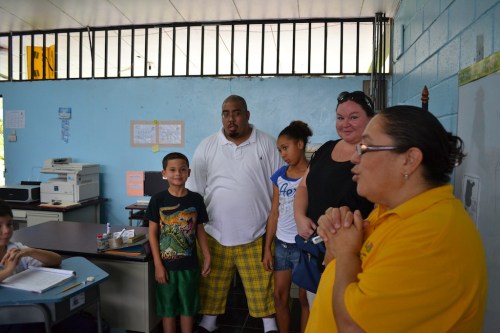
Prior to our Costa Rica trip, we had learned about a program called Pack for a Purpose, in which participating hotels offer the opportunity for guests to bring items from a list to be donated to local schools. Because La Quinta de Sarapiqui is a participating inn, we packed art and school supplies. Dana and her family, fellow “Gift of Happiness” recipients that we met on the trip, had done a drive at their daughter’s school and brought a box of school supplies, backpacks and athletic shoes. When Ana mentioned to our families that she would be visiting the local school, Llano Grande, in the morning, we all jumped at the chance to tag along. Little did we know it would be one of the most special and memorable experiences of our whole trip.

Ana explained to the children, who seemed to range in age from about 9 to 12,  that we were all recipients of a “Gift of Happiness” tour and had come to see the “Happiest Country the Planet” so we could go home and share with others that “Costa Rica is a happy country, full of smiles”.

The kids were all very attentive and interested in the group of visitors. In our matching khaki shorts and cameras, I wanted to say, “We have a uniform, just as you do!” We shared a little bit about where we lived and what we did. I asked (in the best Spanish I could) what the students wanted to be when they grew up. They went around the room, sharing, some boldly, some shyly, Ana translating as needed. There were two future policemen, a fireman, a writer, an English teacher, more teachers, and two farmers. We were told that many of them were children of pineapple and yucca farmers.

Below, Ana and the Ekarintaragun family. Michael (Lippy) “illustrating” his work as a cartoonist. One boy was especially excited when he said he worked on computer and video games. (We did notice a computer in the classroom.)

At recess time, the kids went outside to play basketball and soccer, joined by the classroom of younger children. It was so much fun to just watch them laugh and play.

Food is harvested from the large school garden throughout the year. We were told that, while primary education is mandatory in Costa Rica, and school lunches subsidized, many children stop their education before high school because the families can no longer afford the lunch. We were also told that some of the children in rural Costa Rica live with as many as five families in a small house. We also learned that the school uniform in Costa Rica is universal, which seems like it would be very helpful for these kids and families, as uniforms can be passed down and other clothes aren’t needed for school.

After washing up, the children went back to their respective classrooms. We gave our supplies to the kids. The teacher mentioned that one boy, who wasn’t there, would be so happy with the shoes, as he didn’t have any. All the kids nodded in agreement.

Anna, the Sarapiqui Inn co-owner, Leo, and the teacher posed with the children.

Michael asked to share one more thought with the kids. In his best Spanish, and a little help from Ana, he told them that it may seem like Americans have a lot of things, but that they, the Costa Rican children, who lived in a beautiful, natural country that cared deeply about and was practicing sustainability, were truly the children of the 21st century. It was a beautiful thought that encapsulated much that we had already learned about Costa Rica in our couple of short days there.

We all left very moved and hoping to be able to visit again.

Stay tuned for Part 5 of our “Gift of Happiness” adventure.

Photos by Susan Sachs Lipman

Costa Rica “Gift of Happiness”, Part 3: La Quinta de Sarapiqui

Read Part 2 of our Gift of Happiness adventure.

After a short ride from the coffee plantation, we arrived at the extremely lush, tropical and friendly inn, La Quinta de Sarapiqui, in the fertile central valley of Costa Rica. Manager Ana greeted us with lemonade in the open-air lobby, and we quickly got settled into our room and then began to explore the surroundings, which included two swimming pools, an enclosed butterfly garden, a forested trail, the Sarapiqui River, educational displays, and a walkway where neon-colored frogs came out at night. Anna felt very at home on the room’s veranda. (See if you can find her, below.)

The butterfly garden was amazing. I love butterflies and the opportunity to see exotic local species close-up was very exciting. I first encountered this magnificent owl butterfly. It was so still, beautiful, perfect and large, that at first I didn’t think it was real. I since learned that the pattern offers camouflage, while the “eye” may also work to fool predators into attacking a non-vital part of the butterfly. Owl butterflies love fermented bananas and pineapples, and the hotel staff had left plenty out. When this one finally flew from its perch, it revealed a stunning periwinkle-colored interior.

The blue morpho is a very common, though no less phenomenal, large and beautiful butterfly with bright, iridescent wings. I saw these throughout Costa Rica.

This is what the blue morpho looks like with its wings closed.

Pretty crimson patch butterflies fed on flower nectar and skittered around the butterfly house.

Ana, La Quinta’s manager, led me out to the nearby Sarapiqui River to see a rare sunbittern and its nest (and egg!)

At night, Anna and I took a walk in what had become a driving rainstorm to see the small poison dart frogs (we were warned about these) and green frogs jumping over the footpaths from one muddy spot to the next. This is La Quinta’s “weather station”.

La Quinta de Sarapiqui has earned a rare 5 leaves, the highest level available from the Costa Rica Tourism Board’s Certification for Sustainable Tourism (CST). Enjoying the grounds and watching Ana and the others care for them, I felt a deep sense of harmony with nature. The hotel is also a teaching facility. I pictured gathered congregations of naturalists.

We noticed that nightfall descended quickly in the Costa Rican valley. Over buffet dinner, we met and chatted with Dana, Chai, Brittany and Cameron, from Florida, who were also on the “Gift of Happiness” tour! And we met a group of students and chaperones from a Michigan high school. We stayed in the open-air lobby, talking and playing low-key games as rain pelted around us. The thunder was among the loudest I’d ever heard.

The next day, we would visit a nearby school. Stay tuned for Part 4 of our Gift of Happiness adventure.

 Photos by Susan Sachs Lipman

Costa Rica “Gift of Happiness”, Part 2: Mi Cafecito Coffee Tour

Read Part 1 of our Gift of Happiness adventure.

We left Costa Rica’s capitol (and largest) city and immediately swung into the charming town of Alajuela, whose pastel-colored farmacias, cafes and small eateries, called sodas, were largely shuttered because it was Sunday. From there, we found ourselves rising through the mountains of Costa Rica, heading north. The landscape was dotted with coffee plantations; squat stucco houses painted pastel pink and bright blue and chartreuse seemingly sunk into the dirt, with small tiled front porches and laundry drying outside on lines; and small pineapple, banana and other farms, or fincas. Carlos explained what each town was known for and what the different fincas were growing. Like many people we would meet in Costa Rica, he also had a great sense of humor and fun.

On the way, we saw a cow (and a man) pulling one of these traditional colorful ox carts. I didn’t get a good picture. Luckily, Red Gage did.

People were selling fruit from stands and in front of homes. We pulled over on a high mountain road to buy some strawberries and Anna apples (yes, they were called that!) Turismo vans, like ours, passed us, threading up into the hills.

We passed one of several stunning waterfalls (I believe this is the La Paz waterfall) and Carlos stopped so I could snap a picture. Families played in the water at its base.

We wound further on mountain roads, surrounded by lush greenery, until we arrived at the Coope Sarapiqui Mi Cafecito coffee plantation.

We quickly met Walter, our extremely knowledgeable and engaging tour guide, who explained that the co-op includes 137 local small coffee growers and that it is committed to organic and fair trade practices and products, which include employing local people — a hallmark of many Costa Rican enterprises that we would come across. Walter is a second-generation co-op member.

We learned how coffee seeds are planted and coffee grown and harvested. This was especially exciting because we had recently taken a tour of the Highwire Coffee roasting plant back home and now we were seeing where similar coffee was grown.

Trees mature in 3-5 years, and coffee fruit is ripe for picking when it turns red. The beans are actually inside this red “coffee cherry” fruit. At busy times of the year, more locals are called in to harvest the seeds.

Each fruit contains 1-3 seeds. Michael, Anna and I each managed to pick a fruit with a different number of seeds. In addition, Anna got a peaberry, which is a single seed, rather than the usual double. (4% of coffee cherries produce peaberries.)

Because the farm is completely organic, pest-control is handled in a low-impact way, by a series of paper cups with alcohol inside, which attracts and then kills beetles and other unwanted creatures.

Walter demonstrated an old hand-cranked machine that shells the fruits and leaves the remaining coffee beans.

This is the newer version:

Coffee beans are then sun-dried, roasted in an oven called an horno, and packed into burlap bags for shipping.

After getting a close-up tour of sustainable coffee making. we trekked through the surrounding forest. It was humid, though not terribly hot, and we were already slapping at new mosquito bites on our apparently delicious North American skin.

The plants and flowers were exotic and beautiful, including the poisonous, hallucinogenic Angel’s Trumpet:

We looked out over the Sarapiqui River and visited the elaborate composting room — not the only one we’d see on our tour of this incredibly eco-conscious country.

Time for lunch and coffee! Lovely meals of house-farmed tilapia, traditional rice and beans, and banana plantains were brought to us. We also enjoyed the dark-roasted full-bodied Mi Cafecito coffee so much that we bought some to bring home.

Photos by Susan Sachs Lipman, Red Gage, Carlos

Stay tuned for Part 3 of our Gift of Happiness adventure.


Snapshot: Fourth Of July

Enjoy your holiday!

Photos by Susan Sachs Lipman

Costa Rica “Gift of Happiness”, Part 1: Arrival in San Jose

We just got back from Costa Rica, thanks to an all-expense-paid trip from the Costa Rican Tourist Board through their Costa Rica’s Gift of Happiness Sweepstakes. It was a terrific and amazing trip in every way — providing adventure, relaxation, stunning natural beauty and diversity, warm and wonderful people, fascinating culture, inspiration about sustainability, and numerous opportunities for us all to practice our very middling Spanish.

Because our trip was scheduled to begin the day after Anna’s school year ended, we experienced a bit of a whirlwind leaving home. Our adventure began immediately, though, with an easy day of flying and arrival in “The Happiest Country on Earth“.

We truly knew we were in excellent, capable and caring hands when Carlos met us at the airport, in a Gift of Happiness shirt and bearing gift bags for each of us, along with a booklet of vouchers we would use throughout the week for hotels, tours and more.

Because we arrived late in the day, our first night was spent at the Ramada Plaza Herradura in San Jose, where the airport is located. It was a fine and vast hotel, with a Catalan-meets-Miami feel. We relaxed, sampled the Costa Rican liquor, Cacique (the brand) guaro, a strong sugar-cane-based, vodka-like liquor, and then a coconut-based cocktail called a Miguelito, while all-purpose international dance music pumped into the lounge.

The next morning we enjoyed the typical Costa Rican breakfast, Gallo Pinto, or rice and beans, along with sumptuous tropical fruits, grilled vegetables and dark bread. We marveled at our good fortune to have landed in this lovely, exotic country for a week and were full and smiling when Carlos came by in the Gift of Happiness van to take us to what he promised would be a very special place.

Photos by Susan Sachs Lipman

Stay tuned for Part 2 of our Gift of Happiness adventure.


Related Posts Plugin for WordPress, Blogger...